Calculate Smarter,
Live Easier
Loan payments, age, BMI, percentages, Zakat and more — all in one place.
Loan Calculator
A loan can make a large purchase easier to manage, but it is important to understand how much you may need to pay each month and how much the loan could cost over time. A loan calculator can help you estimate your monthly payment, total interest, total repayment, and the time needed to pay back borrowed money.
Whether you are checking a personal loan, car loan, home loan, student loan, business loan, or another type of financing, a calculator gives you a simple way to explore different numbers before making a financial decision.
Enter the loan amount, interest rate, and loan term into the calculator to get an estimated payment. You can then change the numbers and compare different repayment periods.
Important: Calculator results are estimates. Your actual payment can be different because lenders may use different interest methods, fees, taxes, insurance, eligibility rules, and loan terms.
Here, you will not just learn how to use a BMI calculator but also understand how it works, why it matters, and how to use it correctly for better health decisions.
Loan Calculator
See your monthly payment, total interest and full payment schedule in seconds.
With Extra Payments
Principal vs Interest by Year
Amortization Schedule
| Payment # | Payment | Principal | Interest | Remaining Balance |
|---|
What Is a Loan Calculator?
A loan calculator is an online tool that estimates the cost of borrowing money.
Most basic calculators ask for three main numbers:
- Loan amount
- Interest rate
- Loan term
Depending on the calculator, you may also enter a down payment, extra monthly payment, fees, or other information.
The result can show your estimated monthly payment, total interest, and total amount paid during the loan term.
For an amortizing loan, each payment normally contains an interest portion and a principal portion. At the beginning of the repayment period, a larger share of the payment can go toward interest. As the principal balance becomes smaller, more of the payment can go toward reducing the principal.
This is why looking only at the monthly payment can give an incomplete picture of the real cost of borrowing.
How Does a Loan Calculator Work?
The calculator uses the information you enter to estimate your repayment schedule.
For a common fixed-rate loan with regular monthly payments, the calculation uses the loan principal, monthly interest rate, and number of monthly payments.
The standard payment formula is:
M = P × [r(1 + r)ⁿ] / [(1 + r)ⁿ – 1]
Where:
- M = estimated monthly payment
- P = principal or original loan amount
- r = monthly interest rate
- n = total number of monthly payments
For example, if the annual interest rate is 6%, the monthly rate used in a simple monthly calculation is 0.5%, or 0.005.
The formula is useful for understanding how the payment is calculated, but you do not need to calculate it by hand. An online calculator can do the math quickly.
Keep in mind that this formula does not represent every type of loan. Some loans use different interest methods, variable rates, fees, payment schedules, or other terms.
What Information Do You Need?
Before using the calculator, collect the basic information about the loan
Loan Amount
This is the amount you plan to borrow.
For a car loan, it may be the amount financed after a down payment. For a home loan, it may be the amount borrowed after considering your down payment. For a personal loan, it may simply be the amount you request.
Interest Rate
The interest rate represents the cost of borrowing.
Some loans use a fixed rate, while others can have a variable rate. When comparing offers, also check whether the lender provides an APR and what fees are included.
For example, the Consumer Financial Protection Bureau explains that APR is a broader measure of borrowing cost because it can include interest and certain fees.
Loan Term
The loan term is the amount of time you have to repay the money.
It may be expressed in months or years.
A longer term can reduce the required monthly payment, but it can also increase the total interest paid over the life of the loan.
How Much Will My Monthly Loan Payment Be?
Your monthly payment depends on several factors, including the amount borrowed, interest rate, and repayment period.
For example, consider a simple $20,000 example at a 4.75% interest rate.
The Consumer Financial Protection Bureau gives the following example for an auto loan:
| Loan Term | Approx. Monthly Payment | Total Interest |
|---|---|---|
| 36 months | $597 | $1,498 |
| 48 months | $458 | $1,999 |
| 60 months | $375 | $2,508 |
| 72 months | $320 | $3,024 |
The example shows an important point. A longer repayment period can lower the monthly payment, but the total interest can be much higher.
This is one reason a loan payment calculator is more useful when you look at both the monthly payment and the total cost.

How Much Interest Will I Pay?
The total interest depends mainly on the loan amount, interest rate, repayment period, and the way interest is calculated.
For a simple fixed-payment example:
Total Interest = Total Payments – Principal
Suppose your estimated monthly payment is $500 and you make 60 payments.
Your total scheduled payments would be:
$500 × 60 = $30,000
If the original loan amount was $24,000:
$30,000 – $24,000 = $6,000
The estimated interest would therefore be $6,000, before considering any separate fees or charges.
Your actual loan agreement may use different calculations, so always check the lender’s terms.
How Long Will It Take to Pay Off a Loan?
The answer depends on your loan balance, interest rate, required payment, and any additional payments you make.
A how long to pay off a loan calculator can help estimate the payoff period.
If you make only the required payment, the loan may follow its original schedule. If you pay extra toward the principal, you may be able to reduce the balance faster.
However, the effect of extra payments depends on the loan agreement and how the lender applies additional money. The Consumer Financial Protection Bureau notes that paying down principal faster can reduce the amount of interest paid on an auto loan, but borrowers should check their loan documents.
Can I Pay Off a Loan Faster?
Sometimes, making additional payments can help reduce the loan balance sooner.
There are several things you can compare:
- Your normal monthly payment
- An additional amount paid each month
- Occasional extra payments
- A shorter repayment term
- A different interest rate
A payoff calculator can show how changing the payment amount may affect the estimated payoff date.
Before making extra payments, check your loan agreement. Some loans can have prepayment rules or penalties, while others may allow extra principal payments without a charge.
Do not assume that every extra payment will work in the same way. Ask the lender or loan servicer how additional payments are applied.
How to Pay Off a Car Loan Faster
A car loan is one of the most common situations where people compare different repayment periods.
If your goal is to pay the balance faster, you can use a car loan calculator to compare different payment amounts and loan terms.
For example, you could compare:
Option A: Normal monthly payment
Option B: Normal payment plus an additional amount
Option C: A shorter loan term
The best option depends on your own loan agreement and budget.
It is also important to look beyond the monthly payment. The CFPB recommends comparing the loan amount, APR, interest rate, loan length, and total amount financed when evaluating auto loans.
How Much Interest Will I Pay on a Car Loan?
Your total auto loan interest depends on the amount financed, rate, and term.
A longer car loan can make the monthly payment look smaller, but the total interest can be higher. The CFPB’s example shows a $20,000 loan at 4.75% costing $1,498 in interest over 36 months compared with $3,024 over 72 months.
That difference demonstrates why a car loan calculator should be used to examine the complete repayment picture, not just the monthly amount.
How Much Car Loan Can I Afford?
A calculator can estimate payments, but it cannot decide what you personally can afford.
Your real vehicle cost can include more than the loan payment. Depending on your location and situation, you may also have insurance, fuel, maintenance, registration, taxes, and other expenses.
A lender may also consider factors such as income, existing debts, credit history, loan amount, term, and down payment when deciding loan terms.
So a how much car loan can I afford calculator should be treated as a planning tool rather than a loan approval tool.
Home Loan Calculator: How Much Can I Afford?
A home loan is usually much larger and longer than a typical personal or auto loan.
A home loan calculator can help you estimate a monthly payment based on the amount borrowed, interest rate, and loan term.
However, estimating how much house you can afford requires more than the mortgage payment.
You may also need to consider:
- Down payment
- Property taxes
- Home insurance
- Maintenance
- Closing costs
- Other debts
- Income
- Emergency savings
This is why a how much home loan can I qualify for calculator can only provide an estimate unless it is connected to a lender’s actual eligibility rules.
A calculator can help you explore numbers, but it does not guarantee approval.

Mortgage Loan Calculator
A mortgage loan calculator is designed around home financing.
You can use it to compare different combinations of:
- Home price
- Down payment
- Loan amount
- Interest rate
- Repayment period
For example, increasing your down payment may reduce the amount you need to borrow. Changing the loan term can change both your monthly payment and total interest.
If you are researching a mortgage, do not compare offers only by the monthly payment. Review the complete borrowing cost and the terms attached to each offer.
Personal Loan Calculator
A personal loan calculator can help estimate payments for a personal loan.
Personal loans may be used for different purposes, depending on the lender and local rules. The interest rate and terms can vary significantly between borrowers and lenders.
Use the calculator to compare different loan amounts and repayment periods before looking at a specific offer.
For example, you can enter one loan amount with a shorter term and then compare it with a longer term. This can help you see how the monthly payment and total interest change.
Personal Loan Calculator
A student loan can have repayment rules that are different from ordinary consumer loans.
A student loan calculator can help estimate monthly payments, total repayment, and payoff time, depending on the information included in the tool.
For some student loans, repayment can depend on factors beyond the original balance and interest rate. In the United States, for example, Federal Student Aid provides a Loan Simulator that can compare estimated monthly payments, total paid, repayment periods, and other repayment outcomes. It also warns that its estimates are not guaranteed future payments.
This is a good example of why calculators should be viewed as estimates rather than promises.
How Fast Can I Pay Off My Student Loan?
To estimate how quickly a student loan could be repaid, you need information such as:
- Current balance
- Interest rate
- Required payment
- Extra payment amount
- Repayment frequency
A how fast can I pay off my student loan calculator can compare different payment scenarios.
For example, you could compare the original payment with a higher monthly payment and see how the estimated payoff period changes.
Student loan rules can vary by country and loan program, so use the rules provided by your lender or official student loan authority when making real repayment decisions.
What Loan Types Can You Calculate?
Loan calculators can be used for different types of loans. Here are some common loan types you can calculate:
Auto Loan Calculator
An auto loan calculator helps estimate monthly payments for buying a car.
Home Loan Calculator
A home loan calculator helps estimate monthly payments for a home or mortgage loan.
Personal Loan Calculator
A personal loan calculator helps estimate payments for a personal loan.
Student Loan Calculator
A student loan calculator helps estimate payments for an education loan.
Business Loan Calculator
A business loan calculator helps estimate payments for business financing.
Home Equity Loan Calculator
A home equity loan calculator estimates payments based on the loan amount, interest rate, and repayment term.
Vehicle Loan Calculator
A vehicle loan calculator helps estimate payments for financing a vehicle.
Other specialized tools can include RV loan calculators, boat loan calculators, commercial loan calculators, FHA loan calculators, VA loan calculators, and interest-only loan calculators.
The exact calculation method can differ between loan products, so the calculator should clearly explain what assumptions it uses.

Loan Calculator Pakistan
For users in Pakistan, a loan calculator can help estimate monthly installments and total repayment for different financing scenarios.
Common terms include:
- Loan amount
- Interest rate
- Monthly installment
- Loan tenure
- Principal amount
- Total repayment
- Financing
- Interest calculation
If you are comparing a bank or financing product, the calculator should not be treated as an official quote from that institution.
Users may search for tools such as:
HBL loan calculator, UBL car loan calculator, MCB car loan calculator, Meezan Bank car loan calculator, Faysal Bank car loan calculator, Bank Alfalah car loan calculator, BOP car loan calculator, and NBP loan calculator.
These searches can relate to specific products, and the actual terms can change. Always check the bank’s current official information before relying on a specific rate, fee, or eligibility requirement.
For a general estimate, a calculator can still help you understand how the loan amount, rate, and repayment period affect the payment.
Loan Calculator India
Indian users commonly use terms such as EMI, loan tenure, principal, interest, and monthly installment.
An EMI loan calculator can estimate the Equated Monthly Installment for a loan using the amount, interest rate, and repayment period.
Depending on the type of borrowing, users may search for:
- Home loan calculator India
- Personal loan calculator India
- Car loan calculator India
- EMI calculator India
- SBI loan calculator
- HDFC loan calculator
- ICICI personal loan calculator
- Gold loan calculator
A general calculator is useful for comparing scenarios, but bank-specific rates and eligibility should always be confirmed with the relevant lender.
Loan Calculator USA
In the United States, borrowers may use terms such as monthly payment, principal, APR, loan term, financing, and total interest.
A general calculator can help estimate payments for personal loans, auto loans, mortgages, student loans, business loans, and other financing.
For some government-backed products, separate eligibility rules apply. For example, FHA, VA, and USDA loan programs have their own requirements. A general calculator should not claim that it can determine official eligibility unless it actually uses the required official criteria.
What Is the Difference Between Interest Rate and APR?
Interest rate and APR are related but not always identical.
The interest rate represents the rate charged on the borrowed amount. APR is a broader measure that can include the interest rate and certain fees.
This distinction matters when comparing loan offers.
For example, two loans could appear similar when you look only at the interest rate, but their total borrowing costs may differ because of fees and other charges.
For auto loans in the United States, the CFPB recommends comparing APRs with APRs rather than comparing an APR from one offer with an interest rate from another.
Why Does a Longer Loan Term Cost More?
A longer loan term spreads repayment over more months.
That can make the required monthly payment smaller, but interest has more time to accumulate.
Consider the CFPB’s $20,000 auto loan example at 4.75%:
| Term | Monthly Payment | Total Interest |
|---|---|---|
| 3 years | $597 | $1,498 |
| 4 years | $458 | $1,999 |
| 5 years | $375 | $2,508 |
| 6 years | $320 | $3,024 |
The six-year option has the lowest monthly payment in the example, but the highest total interest.
This is why a how long to repay loan calculator can be useful when comparing repayment periods.

Should I Choose a Shorter or Longer Loan?
There is no single term that works for everyone.
A shorter term generally means higher scheduled payments but less time for interest to accumulate.
A longer term can reduce the scheduled monthly payment, but it may increase the total interest cost.
The right comparison depends on the loan, your financial situation, the lender’s terms, and your ability to make payments consistently.
Instead of asking only, “What is the lowest monthly payment?”, also look at:
How much will I pay in total?
That question can reveal a very different picture.
What Is an Amortization Schedule?
An amortization schedule shows how payments are divided between principal and interest over time.
At the beginning of an amortizing loan, a larger portion of the payment may go toward interest. As the principal decreases, a larger portion can go toward the principal.
The exact schedule depends on the loan terms and calculation method.
An amortization schedule can help answer questions such as:
- When will my loan be paid off?
- How much interest will I pay?
- How much principal have I repaid?
- What happens if I make extra payments?
- How does changing the loan term affect the total cost?
How to Use a Loan Calculator
Using an online calculator is simple.
Step 1: Enter the Loan Amount
Enter the amount you expect to borrow.
Step 2: Enter the Interest Rate
Use the rate provided by the lender or the rate you want to test.
Step 3: Enter the Loan Term
Choose the number of months or years you expect to take to repay the loan.
Step 4: Calculate
Review the estimated monthly payment.
Step 5: Compare Different Scenarios
Change the loan amount, rate, or term and compare the results.
This last step is often the most useful. A calculator is not only for getting one number. It can help you understand how different assumptions change the cost.
How to Reduce Your Total Loan Cost
There are several factors that can affect the total cost of borrowing.
A lower interest rate can reduce interest charges. A shorter repayment period can also reduce the amount of time interest accumulates.
Making additional principal payments may reduce the balance faster when the loan terms allow it.
However, always check the agreement before making extra payments or paying off a loan early. Some loans may have prepayment conditions or other rules.
For auto loans, the CFPB notes that borrowers should look at the APR, loan length, total amount financed, and other costs instead of focusing only on the monthly payment.
What Loan Should I Pay Off First?
If you have several loans, the answer depends on your individual circumstances and the terms of each loan.
A useful comparison can include:
- Outstanding balance
- Interest rate
- Required monthly payment
- Fees
- Remaining term
- Prepayment rules
A calculator can help you model different repayment scenarios, but it cannot determine the right choice for every borrower.
If you are comparing several debts, make sure you understand whether an extra payment will reduce principal and how the lender applies it.
Can a Loan Calculator Tell Me If I Will Be Approved?
No.
A standard loan calculator estimates payments. It does not normally have access to your lender’s underwriting system.
Loan approval can depend on factors such as income, credit history, existing debt, loan purpose, down payment, employment, collateral, and lender-specific rules.
Therefore, phrases such as how much loan can I qualify for calculator or how much can I borrow calculator should be understood as estimation searches unless the tool is directly connected to a lender’s official eligibility system.
The calculator can help you explore a possible payment. It cannot guarantee approval.
Can a Calculator Tell Me How Much House I Can Afford?
It can provide an estimate, but affordability is broader than a mortgage payment.
For a realistic home budget, consider the complete housing cost and your other regular expenses.
A calculator may help you test different home prices, down payments, rates, and loan terms. You can then compare the results with your budget.
Do not treat the highest calculated amount as the amount you should borrow.
Loan Calculator vs. Loan Eligibility Calculator
These two tools have different purposes.
| Tool | Main Purpose |
|---|---|
| Loan Calculator | Estimates payments and total cost |
| Loan Eligibility Calculator | Estimates possible borrowing eligibility |
| Loan Affordability Calculator | Helps compare borrowing with income and expenses |
| Loan Payoff Calculator | Estimates how long repayment may take |
| Amortization Calculator | Shows principal and interest over time |
| EMI Calculator | Estimates regular installment payments |
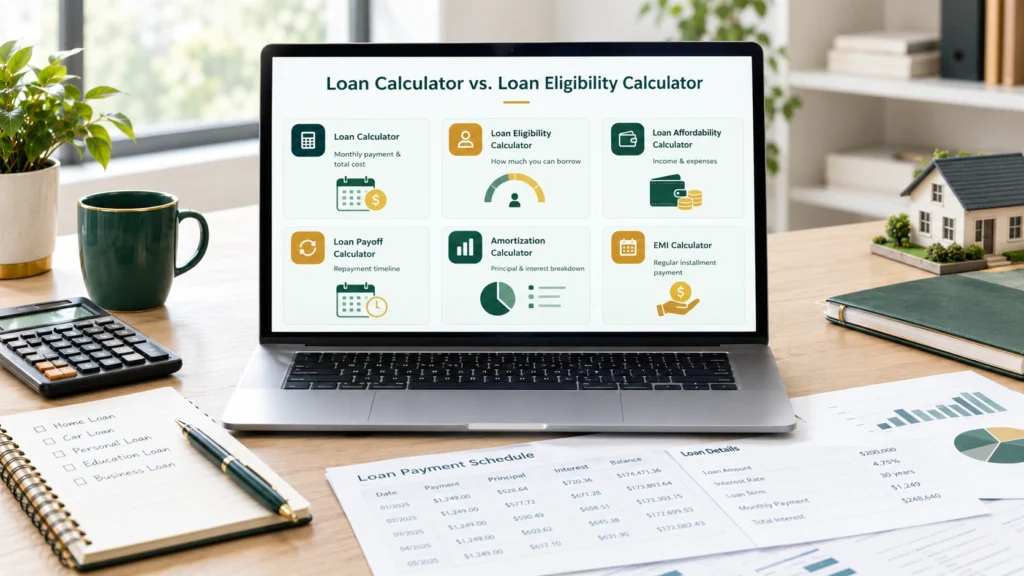
A website can offer several of these tools because users often have different questions during the borrowing process.
Common Loan Calculator Mistakes
One common mistake is looking only at the monthly payment.
Another is ignoring the total interest.
Some people also forget to check fees, insurance, taxes, or other charges that may not be included in a simple calculator.
Another problem is entering the wrong interest rate or loan term.
For example, if a calculator expects an annual percentage rate but you enter a monthly rate, the result can be very different.
Always check what each input field means before calculating.
Final Thoughts
A loan calculator is most useful when you use it to understand the complete cost of borrowing instead of focusing on one number.
Start with the loan amount, interest rate, and repayment term. Then look at the estimated monthly payment, total interest, and total amount paid.
Try several scenarios. A different loan term can change the monthly payment significantly, while the total interest can move in the opposite direction.
For car financing, home financing, personal borrowing, student loans, or business financing, the same basic idea applies: understand the payment today and the total cost over time.
Use the calculator as a planning tool, then check the official loan agreement or lender information before making a real borrowing decision.
Explore More Calculators
Frequently Asked Questions
A loan calculator is an online tool that estimates loan payments using information such as the loan amount, interest rate, and repayment term.
It depends on your income, regular expenses, existing debts, interest rate, repayment period, and lender requirements. A calculator can help estimate payments, but it cannot decide what you can safely afford.
The amount depends on the loan balance, interest rate, repayment period, and calculation method. Entering these details into a calculator can provide an estimate of total interest.
The payoff time depends on your balance, interest rate, required payment, and extra payments. A payoff calculator can compare different payment scenarios.
Some loans allow early repayment, while others may have specific conditions. Check your loan agreement and ask your lender how early payments are handled.
You can compare higher monthly payments, extra principal payments, or a shorter loan term. Before making extra payments, check how your lender applies them and whether any prepayment conditions apply.
EMI means Equated Monthly Installment. It is a regular payment used for certain types of loans, especially in markets where EMI is a common lending term.
A calculator can be mathematically accurate based on its inputs and assumptions, but the result may not match an actual lender quote. Fees, taxes, insurance, variable rates, payment timing, and lender-specific rules can change the final cost.
Generally, spreading the same loan over more payments can reduce the scheduled monthly payment. However, it can also increase the total interest paid over the life of the loan.
A calculator can help you compare numbers such as monthly payments and total interest. It cannot determine which loan is best for your personal situation.
Yes. A loan calculator can estimate your total payments by combining the principal amount and estimated interest over the repayment period.
Yes. Paying extra toward the principal may help you repay the loan sooner and can reduce the total interest, depending on the loan terms.
Monthly payments can change when the interest rate or repayment period changes. A longer term usually spreads the balance across more payments.
Yes. You can enter different repayment periods and compare the estimated monthly payment, total interest, and overall loan cost.
Not always. Basic calculators usually focus on principal and interest, while actual borrowing costs may also include fees, taxes, insurance, or other charges.
Yes. If the calculator includes a payoff feature, it can estimate the repayment date based on the loan amount, payment schedule, and any extra payments.
Yes. Using a calculator before applying can help you explore different loan amounts, interest rates, and repayment terms before discussing actual loan terms with a lender.