Pregnancy Due Date Calculator
A pregnancy due date calculator helps you estimate when your baby may arrive. You can use it to find your estimated due date, understand how many weeks pregnant you are, and follow your pregnancy timeline. The result depends on the information you enter, such as the first day of your last menstrual period, your conception date, or your IVF embryo transfer date.
For most pregnancies, the estimated due date is calculated as 40 weeks, or 280 days, from the first day of the last menstrual period. However, every pregnancy is different, and your baby may arrive before or after this date. The American College of Obstetricians and Gynecologists (ACOG) explains that the due date is an estimate used to track pregnancy progress, not a guarantee of the delivery date.
Our online pregnancy due date calculator is designed to make this process easier. Enter the required dates, review your estimated results, and use the information as a starting point for discussions with your healthcare professional.
Many people use a Zakat calculator to calculate their Zakat and understand how much they may need to pay on their eligible wealth. It helps estimate 2.5% Zakat on qualifying savings, cash, gold, silver, and other eligible assets after considering applicable liabilities. Simply enter your financial details to get an estimated Zakat amount and make your calculation easier.
Pregnancy Due Date Calculator
Estimate your due date, pregnancy week, trimester and days remaining.
Estimated due date
Your due date is an estimate, not a guaranteed delivery date. This tool is educational, cannot confirm a pregnancy or assess your baby's health, and is not a clinically confirmed due date. Please discuss your results with a qualified healthcare professional.
What Is a Pregnancy Due Date?
A pregnancy due date, also called an estimated due date (EDD), is the date when a pregnancy reaches approximately 40 weeks of gestational age.
Gestational age is measured from the first day of your last menstrual period, not from the exact day of conception. This is why pregnancy dating usually begins about two weeks before conception in a typical 28-day menstrual cycle.
For example, someone who is counted as four weeks pregnant may have conceived approximately two weeks earlier. The exact timing can vary because ovulation does not occur on the same day in every cycle.
Your due date helps healthcare professionals plan prenatal appointments, monitor the baby’s growth, and decide when certain pregnancy tests may be needed.
According to ACOG, only about 1 in 20 babies are born on their estimated due date. Therefore, it is better to think of the date as a useful guide rather than an exact prediction.
How Is a Pregnancy Due Date Calculated?
There are several ways to estimate a baby’s arrival date. The most suitable method depends on your menstrual cycle, whether you know your conception date, and whether the pregnancy resulted from IVF.
1. Calculation Based on Your Last Menstrual Period
The last menstrual period method is commonly used for an initial due date estimate.
The standard calculation is:
Estimated due date = First day of your last menstrual period + 280 days
This method assumes a 28-day menstrual cycle with ovulation occurring around day 14. If your cycles are shorter, longer, or irregular, the estimate may not match your actual pregnancy timing.
For example, if the first day of your last period was January 1, adding 280 days gives an estimated due date of October 8 in a non-leap year.
This method is useful when you remember the date your last period began. If you are unsure about that date, ask your healthcare professional about other ways to estimate your pregnancy.
2. Calculation Based on Conception Date
If you know your conception date, you can use it to estimate when your baby may arrive.
A simplified calculation is:
Estimated due date = Conception date + 266 days
This calculation assumes conception timing is known. However, the date of intercourse is not necessarily the date of conception because sperm can survive for several days in the reproductive tract.
If you are estimating conception from ovulation, remember that ovulation dates can vary from cycle to cycle. A conception-based estimate may therefore differ from an estimate based on your last menstrual period.
3. Calculation Based on Ovulation
Ovulation is the point in the menstrual cycle when an ovary releases an egg. Conception can occur around this time.
If you know your ovulation date with reasonable confidence, adding approximately 266 days can provide a preliminary due date estimate.
However, ovulation tracking apps, calendar estimates, and physical signs cannot always identify the exact day of ovulation. Your healthcare professional can help interpret the dates and determine the most appropriate pregnancy dating method.
4. IVF Pregnancy Due Date Calculation
An IVF pregnancy due date calculator uses information about the embryo transfer rather than relying only on the last menstrual period.
The calculation depends on the embryo’s age at transfer.
| IVF Transfer Type | Approximate Calculation |
|---|---|
| Day-3 embryo transfer | Transfer date + 263 days |
| Day-5 embryo transfer | Transfer date + 261 days |
For example, if a day-5 embryo transfer occurred on January 10, the estimated due date would be around September 28 in a non-leap year.
These calculations follow the approach described in ACOG’s guidance on estimating due dates. Your fertility clinic’s dating information should take priority over a general online estimate.
An IVF pregnancy calculator should use the actual embryo transfer date and embryo age when those inputs are available. If your calculator does not support IVF, do not use its standard last-period calculation as a substitute for an IVF-specific estimate.
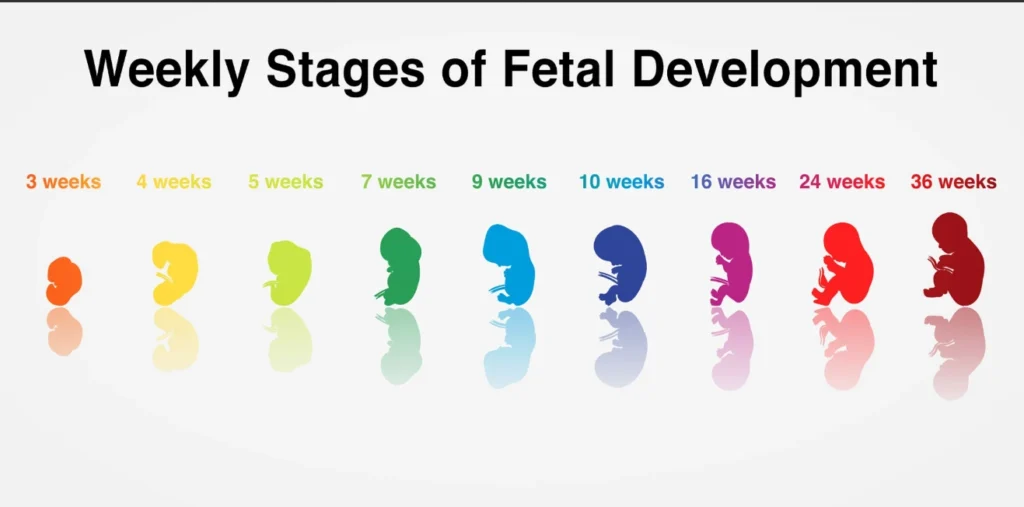
How to Use the Pregnancy Due Date Calculator
Using a pregnancy calculator is simple. The exact steps depend on the options available in the tool.
- Choose your calculation method. Select the method supported by the calculator, such as the last menstrual period or conception date.
- Enter the required date. If you are using the menstrual period method, enter the first day your last period started.
- Add any extra details. Some calculators ask about your average menstrual cycle length. IVF calculations may require an embryo transfer date and embryo age.
- Calculate your result. Select the calculate button to view your estimated due date.
- Review your pregnancy timeline. If supported, check your estimated pregnancy week, trimester, and remaining time until your due date.
For example, if your last menstrual period started on January 1, a standard calculation would estimate a due date around October 8 of the same year. This example assumes a typical 28-day cycle and uses the standard 280-day calculation.
Remember that a calculator provides an estimate. Your healthcare professional may confirm or adjust your estimated due date using your medical history and ultrasound findings.
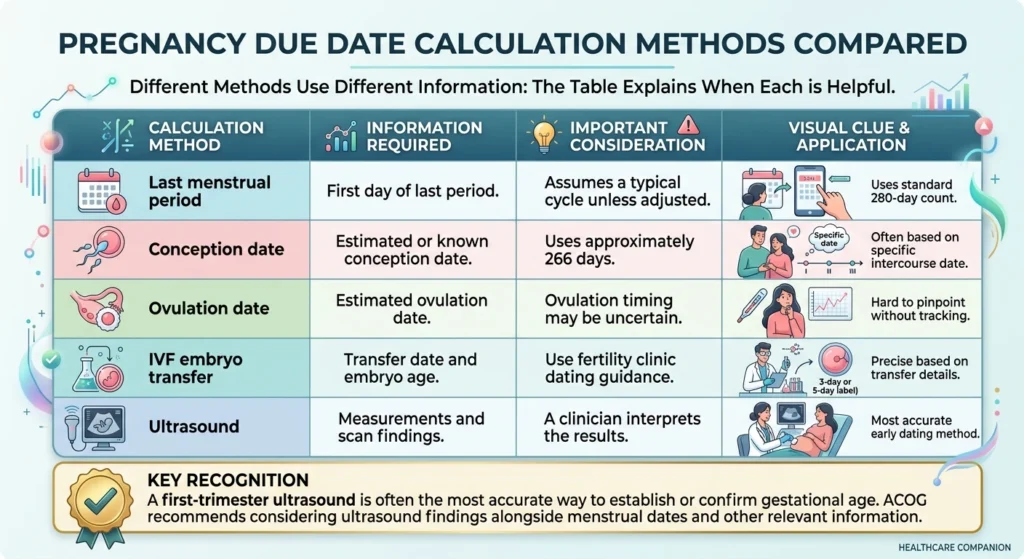
Pregnancy Due Date Calculation Methods Compared
Different methods use different information. The table below explains when each method may be helpful.
| Calculation Method | Information Required | Important Consideration |
|---|---|---|
| Last menstrual period | First day of last period | Assumes a typical cycle unless adjusted |
| Conception date | Estimated or known conception date | Uses approximately 266 days |
| Ovulation date | Estimated ovulation date | Ovulation timing may be uncertain |
| IVF embryo transfer | Transfer date and embryo age | Use fertility clinic dating guidance |
| Ultrasound | Measurements and scan findings | A clinician interprets the results |
A first-trimester ultrasound is often the most accurate way to establish or confirm gestational age. ACOG recommends considering ultrasound findings alongside menstrual dates and other relevant information.
How Many Weeks Pregnant Am I?
A pregnancy due date calculator can help estimate how far along you are. Pregnancy is generally tracked in weeks and days, starting from the first day of the last menstrual period.
For example, 12 weeks and 3 days means 12 full weeks plus three additional days.
If your estimated due date is known, pregnancy age can be calculated by counting the time between your current date and the due date, then comparing it with the standard 280-day pregnancy timeline.
A simple formula is:
Pregnancy age in days = 280 – Days remaining until the estimated due date
Divide the result by seven to convert the number of days into weeks. The remaining days give you the additional days of pregnancy.
This formula is a simplified estimate and assumes a 280-day pregnancy timeline. Your clinician may use a different established date if an ultrasound or IVF information provides a more appropriate estimate.
Pregnancy Weeks and Months
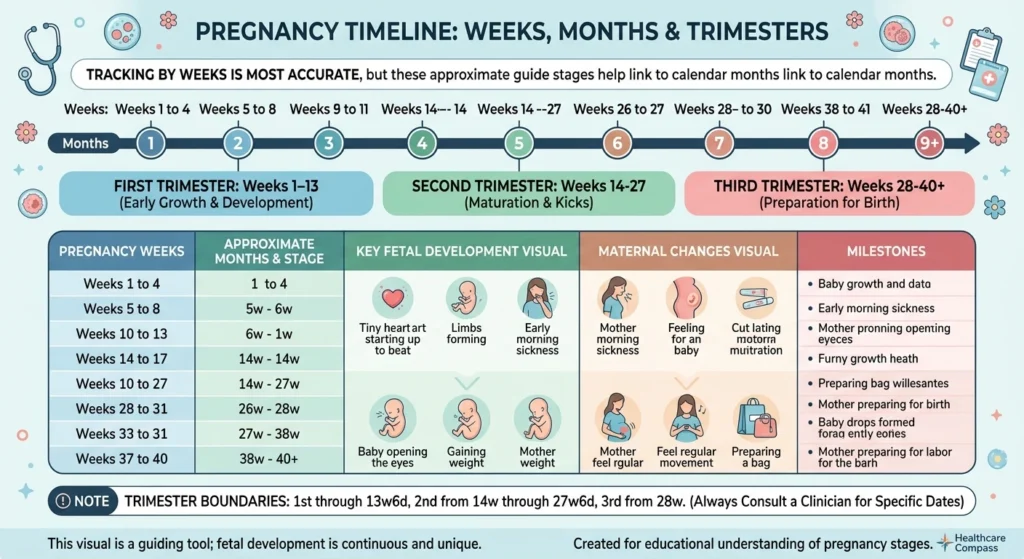
Pregnancy is more accurately tracked in weeks than in calendar months because months do not all have the same number of days.
| Pregnancy Weeks | Approximate Stage |
|---|---|
| Weeks 1 to 4 | Early pregnancy dating period |
| Weeks 5 to 8 | First trimester |
| Weeks 9 to 13 | First trimester |
| Weeks 14 to 17 | Second trimester |
| Weeks 18 to 22 | Second trimester |
| Weeks 23 to 27 | Second trimester |
| Weeks 28 to 31 | Third trimester |
| Weeks 32 to 36 | Third trimester |
| Weeks 37 to 40 | Final weeks of pregnancy |
This table is a simple guide rather than a medical dating chart. Trimester boundaries are commonly described as the first trimester through 13 weeks and 6 days, the second trimester from 14 weeks through 27 weeks and 6 days, and the third trimester beginning at 28 weeks.
What Are the Three Trimesters of Pregnancy?
Pregnancy is divided into three trimesters to make it easier to describe the different stages of development.
First Trimester
The first trimester covers the early stages of pregnancy. It includes the initial development of major organs and body systems.
During this stage, a healthcare professional may confirm the pregnancy, review your health history, and recommend prenatal tests or appointments.
Second Trimester
The second trimester is a period of continued growth and development. Prenatal appointments help monitor the pregnancy and check that development is progressing as expected.
Your healthcare professional may recommend an ultrasound examination to assess the baby’s development and review other important findings.
Third Trimester
The third trimester begins at 28 weeks of pregnancy and continues until birth.
Appointments may focus on the baby’s position, growth, your health, and preparation for delivery. Your clinician can explain what to expect during the final weeks and when to contact your maternity care team.
A due date calculator can help you follow these stages, but it cannot assess your baby’s health or replace prenatal care.
Can a Pregnancy Due Date Calculator Predict the Exact Delivery Date?
No. A pregnancy due date calculator cannot predict the exact day your baby will be born.
The estimated due date is a reference point for tracking pregnancy, not a promise that labour will begin on that day. Many healthy pregnancies continue beyond the estimated date, while others end earlier.
The NHS explains that pregnancy commonly lasts between 37 and 42 weeks when counted from the first day of the last menstrual period. The timing of delivery depends on several factors, and a healthcare professional can advise you about your individual circumstances.
If your pregnancy reaches or passes the estimated due date, continue following the advice of your maternity care team. They can discuss monitoring and possible next steps based on your pregnancy and local medical guidance.
What If My Menstrual Cycle Is Irregular?
An irregular menstrual cycle can make a last-period calculation less reliable.
The standard 280-day method assumes a typical 28-day cycle. If your cycle is longer or shorter, ovulation may happen earlier or later than expected.
For example, someone with a longer cycle may ovulate later than day 14. In that situation, a due date based only on the last menstrual period could be different from the estimate based on actual pregnancy development.
If your periods are irregular or you cannot remember the first day of your last period, tell your healthcare professional. An ultrasound examination and other clinical information may help establish a more reliable estimated due date.
How Accurate Is an Online Pregnancy Due Date Calculator?
An online calculator can provide a useful initial estimate, but its accuracy depends on the quality of the information entered and the method used.
A calculation based on a correctly remembered last menstrual period may be helpful for someone with regular cycles. The result may be less reliable if the date is uncertain, cycles are irregular, or ovulation occurred earlier or later than expected.
ACOG identifies ultrasound measurement in the first trimester as the most accurate method for establishing or confirming gestational age. Even ultrasound dating has a margin of uncertainty, so a due date should always be interpreted in a clinical context.
For the most useful estimate:
- Enter the correct first day of your last menstrual period.
- Provide your actual cycle length if the calculator asks for it.
- Use the correct embryo transfer information for IVF pregnancies.
- Discuss differences between your calculator result and clinical findings with your healthcare professional.
No online tool can confirm that a pregnancy is healthy or predict exactly when labour will begin.
What Should I Do After Finding My Estimated Due Date?
Once you have an estimated due date, arrange or continue prenatal care with a qualified healthcare professional.
Your clinician can confirm your pregnancy dates, recommend appropriate appointments, and explain the tests that may be needed at different stages.
You can also use the date to keep track of pregnancy weeks, prepare questions for appointments, and organize practical plans for the weeks ahead.
Avoid making medical decisions based only on an online calculator. If you have concerns about your pregnancy, seek advice from your healthcare professional.
Explore More Calculators
Final Thoughts
A pregnancy due date calculator is a simple way to estimate when your baby may arrive and understand your pregnancy timeline. Whether you calculate from your last menstrual period, conception date, or IVF transfer date, the result is a starting point rather than a guaranteed delivery date.
For a more reliable estimate, use accurate information and discuss your results with a qualified healthcare professional. Regular prenatal care remains important throughout pregnancy, even when your estimated due date appears clear.
Medical disclaimer: This calculator and its accompanying information are intended for general educational purposes. They do not provide a diagnosis, confirm pregnancy health, or replace advice from a qualified healthcare professional.
Medical References
The following trusted sources explain pregnancy dating, estimated due dates, and the role of ultrasound:
- American College of Obstetricians and Gynecologists (ACOG): Methods for Estimating the Due Date
- ACOG: When Pregnancy Goes Past Your Due Date
- National Health Service (NHS): Pregnancy Due Date Calculator
- ACOG: How Your Fetus Grows During Pregnancy
Per Mattis, pulvinar dapibus leo.
Frequently Asked Questions
A pregnancy due date calculator estimates your baby's arrival date using information such as the first day of your last menstrual period, a known conception date, or IVF embryo transfer details. The result depends on the calculation method and the accuracy of the dates you enter.
The standard method adds 280 days, or 40 weeks, to the first day of your last menstrual period. This method assumes a typical 28-day menstrual cycle and may be less accurate if your cycles are irregular.
Pregnancy age is commonly measured from the first day of your last menstrual period. If your estimated due date is known, you can estimate pregnancy age by subtracting the remaining days until the due date from 280 days.
Yes. If your conception date is known, adding approximately 266 days gives a preliminary estimated due date. The calculation may be less reliable if the conception date is only an estimate.
An ovulation date can provide an estimate when the timing is known. Adding approximately 266 days gives a preliminary result, but ovulation tracking is not always exact.
An IVF due date calculation uses the embryo transfer date and the embryo's age at transfer. For example, a day-5 embryo transfer is generally dated by adding 261 days to the transfer date. Follow your fertility clinic's confirmed dates.
The usual calculation can provide an initial estimated date for a twin pregnancy, but it cannot determine the safest delivery timing. Twin pregnancies may need different monitoring and delivery planning, so follow your obstetrician's advice.
You can obtain an initial estimate if you know your last period date, but irregular cycles can make the result less reliable. Ask your healthcare professional whether ultrasound dating would be more suitable.
No. It is an estimate rather than an exact prediction. A baby may arrive before or after the estimated date, and only a small proportion of babies are born on that exact day.
A due date calculator is not designed to determine the best time to take a pregnancy test. Follow the test instructions and ask a healthcare professional if you are unsure when to test or how to interpret the result.
These terms usually refer to the same date. The estimated date of delivery, often shortened to EDD, is the date used to represent approximately 40 weeks of pregnancy.
Yes. A calendar-based calculator may display your estimated due month and date. However, pregnancy is more accurately tracked in weeks and days rather than calendar months.
If the calculator on this website is offered without charge, you can use it to estimate your due date without paying for the calculation.
It can provide a useful estimate when the correct dates are entered. Its reliability depends on the method used and the accuracy of your information. A healthcare professional can confirm or revise the estimate when needed.
Discuss the difference with your healthcare professional. They can compare the menstrual dates, ultrasound measurements, and any IVF information to determine which estimated due date is most appropriate.