Percentage Calculator
A percentage calculator turns two plain numbers into one clear answer. You type what you have, press a button, and see the result in a second. People use it for exam marks, attendance, sale prices, salary raises, and weight loss.
Percentages look easy, but small mistakes happen often. A student picks the wrong total. A shopper adds two discounts the wrong way. A worker thinks a raise is bigger than it is. This guide shows each method step by step with simple examples, so you can trust your answer every time. You can also try the tool at the top of this page and compare it with the working shown here.
Many people use a pregnancy calculator to estimate their pregnancy weeks, calculate an expected due date, and track their pregnancy timeline. Simply enter the first day of your last menstrual period to get an estimated due date and a helpful overview of your pregnancy progress.
Percentage Calculator
Calculate percentages, exam marks, discounts, increases, decreases, and more.
What Does Percentage Mean?
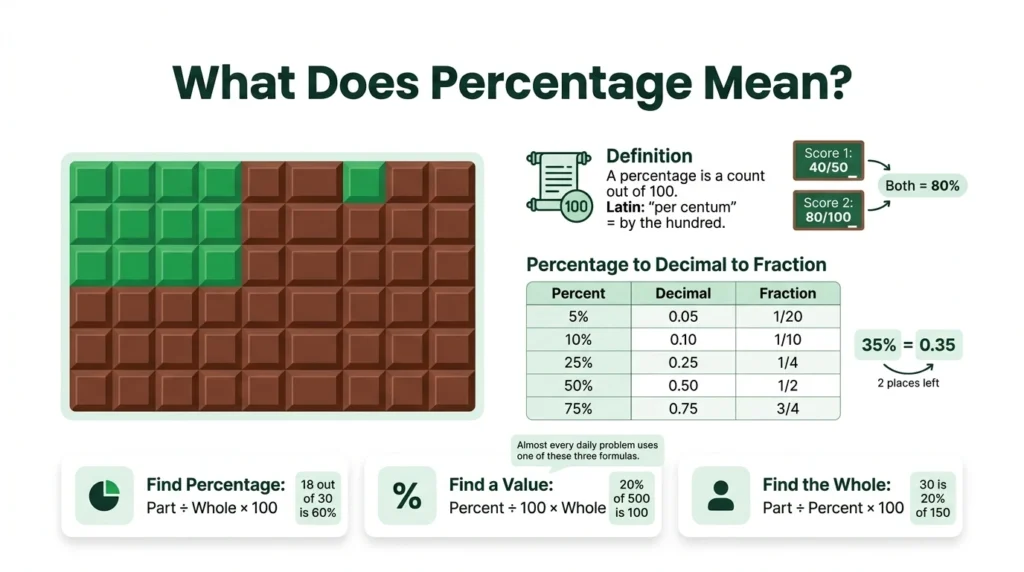
A percentage tells you how many parts you have out of 100. The word comes from the Latin phrase per centum, which means by the hundred. So 25% means 25 out of every 100, or one quarter of the whole.
Picture a chocolate bar with 100 tiny squares. If you eat 25 squares, you ate 25 percent. This is why percentages are so useful. They let you compare things of different sizes. A score of 40 out of 50 and a score of 80 out of 100 look different, but both are 80 percent.
To change a percent into a decimal, move the point two places to the left. So 35% becomes 0.35.
| Percent | Decimal | Fraction |
|---|---|---|
| 5% | 0.05 | 1/20 |
| 10% | 0.10 | 1/10 |
| 25% | 0.25 | 1/4 |
| 50% | 0.50 | 1/2 |
| 75% | 0.75 | 3/4 |
Three Formulas That Solve Most Problems
Almost every daily problem uses one of these three formulas.
| What You Want to Find | Formula | Example |
|---|---|---|
| The percent of a whole | (Part / Whole) x 100 | 18 out of 30 is 60% |
| A value from a percent | (Percent / 100) x Whole | 20% of 500 is 100 |
| The whole from a part | (Part / Percent) x 100 | 30 is 20% of 150 |
If you remember only one row, remember the first. The other two are the same idea turned around.
How to Use Our Online Percentage Calculator
Using our online percentage calculator takes three steps. First, choose your question, such as “What is X% of Y?” or “X is what percent of Y?” Second, type your two numbers. Third, press Calculate and read the answer.
The result appears with the formula used, so you can learn the method and repeat it on paper in an exam.
Marks Percentage Calculator: Find Your Exam Percentage
Most students come here to check exam marks. Add all the marks you scored, add the total marks of all papers, divide, and multiply by 100.
A student scores 78, 84, 91, 69, and 88 in five papers, each out of 100. The marks add up to 410, and the total is 500. Divide 410 by 500 to get 0.82, then multiply by 100. The result is 82 percent.
If your papers have different totals, add the real totals. Say you got 62 out of 75, 40 out of 50, and 85 out of 100. Your marks are 187 and the total is 225. So 187 divided by 225 is 0.831, which is about 83.1 percent.
Negative marking: Subtract the lost marks first. If you got 120 and lost 10 for wrong answers, use 110. In a 200 mark paper, that is 55 percent.
Setting a target: Want 70 percent in a 400 mark exam? Multiply 400 by 0.70 to get 280. You need at least 280 marks.
CGPA to Percentage Calculator
The answer depends on your board or university. There is no single rule used everywhere.
In India, CBSE says CGPA can be turned into a percentage by multiplying it by 9.5. A CGPA of 8.2 becomes 8.2 x 9.5, which is 77.9 percent. Many universities use their own formula, such as (CGPA minus 0.75) x 10, so check your result notice first.
In the United States, GPA is on a 4.0 scale, and schools usually give a letter grade chart. A common chart sets A at 90 to 100, B at 80 to 89, C at 70 to 79, and D at 60 to 69. In Pakistan, each university links marks to grade points in its own table.
For a quick guess, divide your GPA by 4 and multiply by 100. A 3.2 GPA is about 80 percent. This is only a rough estimate. For a job form, visa, or admission, always use the official conversion from your school.
Attendance Percentage
Many schools ask for at least 75 percent attendance. The formula is classes attended divided by total classes, times 100.
If you attended 54 out of 60 classes, that is 54 divided by 60, which is 0.9. Your attendance is 90 percent.
To see how many classes you can miss, multiply total classes by the required percent. With 80 classes and a 75 percent rule, you must attend 60. So you can miss only 20. If you need to count the days between two dates, our date difference calculator can help.
Salary Hike Percentage
A hike formula shows how much your pay has grown. Use (new salary minus old salary) divided by old salary, times 100.
If pay moves from 50,000 to 57,500, the raise is 7,500. Divide 7,500 by 50,000 to get 0.15, a hike of 15 percent.
You can also work forward. A 10 percent raise on 80,000 is 8,000, so the new salary is 88,000. Keep in mind that a bigger percent is not always more money. A 20 percent raise on a small salary can be less than a 10 percent raise on a large one.
Percentage Increase and Decrease
Subtract the old value from the new value, divide by the old value, and multiply by 100. A positive answer is an increase. A negative answer is a decrease.
A price rises from 400 to 500. The change is 100, and 100 divided by 400 is 25 percent. If it falls from 500 back to 400, the change is again 100, but you divide by 500. That is a 20 percent drop, not 25. The starting number is different, so the percent is different.
Here is a puzzle. A price goes up 10 percent, then down 10 percent. Start at 100. It becomes 110, then 99. You end slightly below where you began.
Discount Percentage
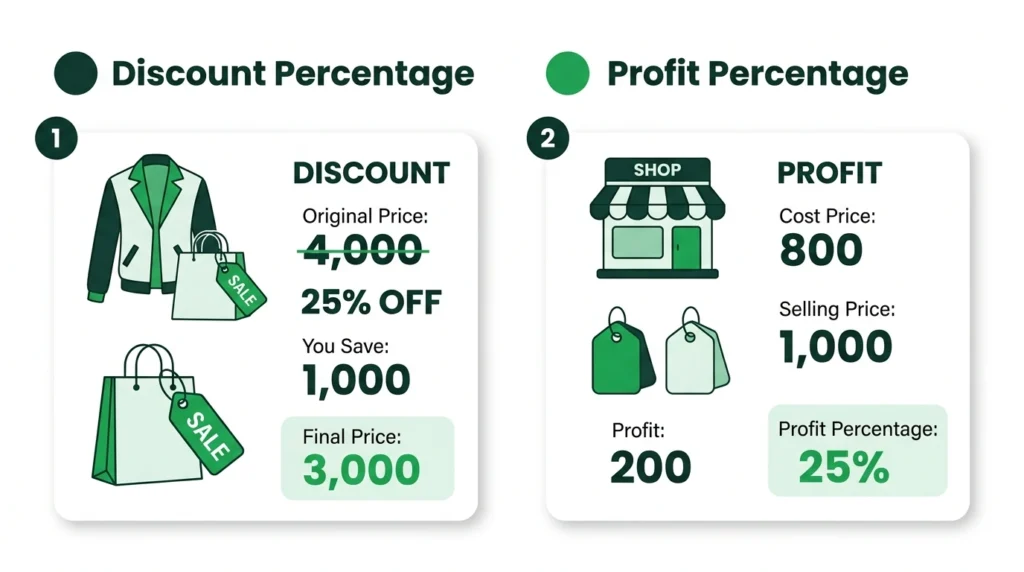
A quick discount check saves time when you shop. A jacket costs 4,000 and the sale is 25 percent off. Multiply 4,000 by 0.25 to get 1,000. You pay 3,000.
If the old price was 5,000 and the new price is 3,500, you saved 1,500. Divide 1,500 by 5,000 to get a 30 percent discount.
Two discounts in a row do not add up. Take 20 percent off 1,000 and you pay 800. Then take 10 percent off 800 and you pay 720. The total saving is 28 percent, not 30.
Finding the original price: If you paid 800 after a 20 percent discount, then 800 is 80 percent of the original. Divide 800 by 0.80 to get 1,000.Profit Percentage
Profit percent uses the cost price as the base. A shopkeeper buys an item for 800 and sells it for 1,000. The profit is 200. Divide 200 by 800 to get 25 percent.
Many people use the selling price as the base by mistake. That gives 20 percent, which is the profit margin, a different measure. Know which one you need before you calculate.
Tax Percentage
Sales tax and GST are percentages too. In the US, sales tax is set by each state and sometimes by the city. In Pakistan, the standard sales tax rate has been 18 percent on many goods. India uses GST with different slabs for different items.
To add tax, multiply the price by 1 plus the tax rate. A 1,000 item with 18 percent tax costs 1,000 x 1.18, which is 1,180. To remove tax from a total, divide by the same number. 1,180 divided by 1.18 is 1,000. Rates change from time to time, so check the official government website before filing or invoicing.
Body Fat Percentage Calculator
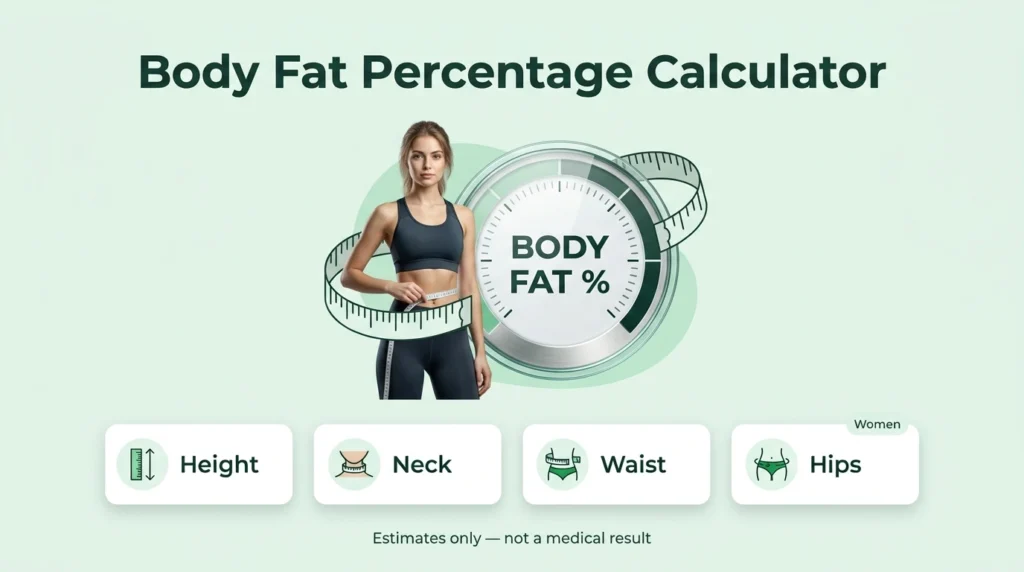
A body fat percentage calculator estimates how much of your weight is fat. This is different from BMI, which only compares height and weight and cannot tell muscle from fat. Many tools use the US Navy method, which needs your height, neck, and waist, plus hips for women.The American Council on Exercise gives these general ranges.
The American Council on Exercise gives these general ranges.
| Group | Men | Women |
|---|---|---|
| Essential fat | 2 to 5% | 10 to 13% |
| Athletes | 6 to 13% | 14 to 20% |
| Fitness | 14 to 17% | 21 to 24% |
| Average | 18 to 24% | 25 to 31% |
These are estimates, not medical results. A doctor or trained health professional can give a better reading. To check your weight status, you can also try our BMI calculator.
For weight loss, use (starting weight minus current weight) divided by starting weight, times 100. Going from 90 kg to 81 kg is a 10 percent loss.
A Note on Love Tests
A love test that takes two names is only for fun. It uses a trick or a random number and cannot measure real feelings. Enjoy it with friends, but do not use it to make real decisions.
Quick Mental Math Tricks
To find 10 percent of a number, move the decimal one place left. 10 percent of 640 is 64. Half of that is 5 percent, which is 32. Double it for 20 percent, which is 128. For 15 percent, add 10 and 5 percent, which gives 96.
You can also flip the numbers. 8 percent of 50 equals 50 percent of 8, which is 4.
Common Mistakes to Avoid
The first mistake is using the wrong base. Always ask, “percent of what?” The second is mixing up percent and percentage points. A rate moving from 10 to 12 percent rises by 2 percentage points, but grows by 20 percent. The third is forgetting to use the decimal form when you multiply. Ten percent is 0.10, not 10. The fourth is rounding too early. Keep full decimals and round only the final answer.
Why You Can Trust This Page
Every formula here is a standard school math formula, and every example was worked out step by step. You can repeat each one in the calculator and see the same answer. For topics where rules depend on a board, a university, or a government, such as CGPA conversion and tax rates, we point you to the official source instead of guessing. If you spot an error, please contact us so we can fix it.
Explore More Calculators
Frequently Asked Questions
Multiply the number by the percentage and divide by 100. For example, 15% of 200 is 30 because (200 × 15) ÷ 100 = 30.
Divide the marks you obtained by the maximum possible marks, then multiply by 100. For example, if you score 425 out of 500, your percentage is 85%.
CGPA conversion depends on your educational board or university. Some institutions use CGPA × 9.5, while others follow different formulas. Check your institution's official guidelines for the correct conversion.
Subtract the old value from the new value, divide the difference by the old value, and multiply by 100. For example, an increase from 100 to 120 is a 20% increase.
Divide the discounted price by 1 minus the discount rate expressed as a decimal. For example, if an item costs 800 after a 20% discount, its original price was 1,000 because 800 ÷ 0.80 = 1,000.
Many schools and colleges require at least 75% attendance, but the minimum requirement varies by institution, course, and local rules. Check your institution's attendance policy to confirm the required percentage.
Percent describes a relative proportion, while percentage points measure the direct difference between two percentages. For example, an increase from 10% to 12% is a rise of 2 percentage points, equivalent to a 20% relative increase.
Yes, GetCalculatorHub's percentage calculator is designed to help users calculate percentages online without doing the calculations manually. It can help with marks, discounts, increases, decreases, and everyday percentage calculations.
Subtract the new value from the original value, divide the difference by the original value, and multiply by 100. For example, a price that drops from 200 to 150 has decreased by 25%.
The basic percentage formula is: Percentage = (Part ÷ Whole) × 100. For example, if you answer 30 out of 40 questions correctly, your score is (30 ÷ 40) × 100 = 75%.
Multiply 500 by 20 and divide by 100. The answer is 100. You can use the same method to calculate any percentage of a number.
Subtract the sale price from the original price, divide the difference by the original price, and multiply by 100. For example, if a product's price drops from 1,000 to 800, the discount is 20%.
Find the absolute difference between the two values, divide it by their average, and multiply by 100. For example, the percentage difference between 40 and 60 is 40% because the difference is 20 and the average is 50.
Yes. Convert the percentage into a decimal and multiply it by the number. For example, 10% of 300 is 30 because 10% equals 0.10 and 300 × 0.10 = 30. An online percentage calculator can make the process faster.
A percentage calculator can help you calculate exam marks, shopping discounts, price increases, salary changes, attendance, business profits, and other percentage-based values. Enter the relevant numbers and choose the calculation that matches your needs.