
Zakat Calculator Pakistan: How to Calculate Zakat on Cash, Gold, Silver and Savings
Zakat is one of the important financial obligations in Islam. For Muslims in Pakistan, calculating Zakat can sometimes feel confusing because a person may have different types of assets, such as cash, bank savings, gold, silver, business assets, and investments.
A Zakat Calculator Pakistan can make this process easier by helping you estimate the amount of Zakat based on your eligible assets and liabilities.
In this guide, you will learn what Zakat is, how the basic Zakat calculation works, what Nisab means, how Zakat may apply to cash and gold, and how you can use an online Zakat calculator to estimate your amount.
What Is Zakat?
Zakat is a mandatory form of charitable giving for eligible Muslims who possess wealth above the applicable Nisab threshold for the required period.
The commonly used basic rate for many forms of zakatable wealth is
2.5% of eligible wealth
For example, if your Zakatable wealth is PKR 500,000 and the applicable conditions are met:
PKR 500,000 × 2.5% = PKR 12,500
Therefore, the estimated Zakat would be PKR 12,500.
The actual calculation can be more complicated when you have several types of assets and eligible liabilities.
What Is a Zakat Calculator?
A Zakat Calculator is an online tool designed to help users estimate their Zakat based on information about their assets and, where applicable, deductible liabilities.
Instead of calculating everything manually, you can enter relevant amounts and use the calculator to get an estimate.
For users in Pakistan, a calculator can be particularly useful when amounts are entered in Pakistani Rupees (PKR).
A Zakat calculator may consider items such as:
- Cash in hand
- Money in bank accounts
- Gold
- Silver
- Business assets
- Investments
- Other Zakatable wealth
- Eligible short-term liabilities
The exact fields depend on the calculator and the calculation method being used.
How to Calculate Zakat in Pakistan
The basic calculation can be expressed as:
Zakat = Net Zakatable Wealth × 2.5%
To estimate your Zakat, you generally need to:
- Identify your Zakatable assets.
- Add their eligible values.
- Consider eligible liabilities according to the method you follow.
- Determine whether your wealth meets the applicable Nisab.
- Apply the relevant Zakat rate.
- Review the result with a qualified scholar if your situation is complicated.
Simple Example
| Asset | Amount |
|---|---|
| Cash | PKR 100,000 |
| Bank savings | PKR 300,000 |
| Gold value | PKR 200,000 |
| Other eligible assets | PKR 100,000 |
| Total | PKR 700,000 |
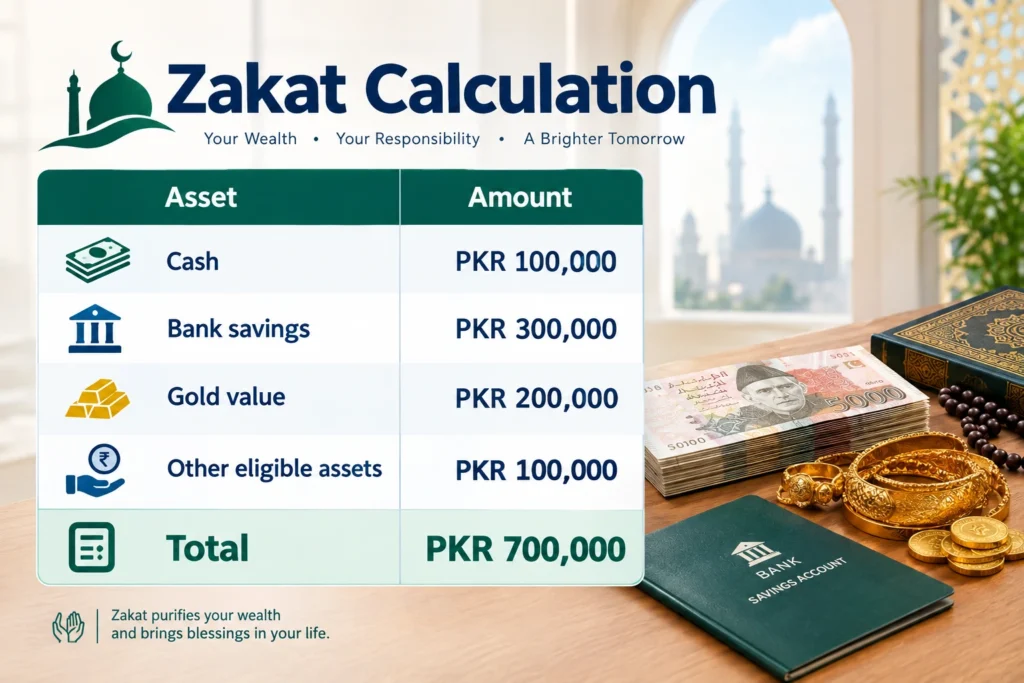
If the entire amount is considered Zakatable under the person’s applicable rules:
PKR 700,000 × 2.5% = PKR 17,500
The estimated Zakat would therefore be PKR 17,500.
This is only an example. The actual amount depends on your assets, liabilities, Nisab, valuation date, and the rules you follow.
What Is Nisab?
Nisab is the minimum level of wealth at which Zakat becomes applicable when the other required conditions are met.
Nisab is traditionally associated with specific amounts of gold or silver.
Because the market prices of gold and silver change, the monetary value of Nisab can also change.
This is one reason why people should avoid relying on an old fixed PKR figure without checking the relevant current values.
Gold and Silver Nisab
Traditional discussions commonly refer to:
- Gold Nisab: 87.48 grams
- Silver Nisab: 612.36 grams
Different sources may present slightly different gram conversions because of rounding and unit conventions.
The monetary value is calculated using the relevant current market price.
Zakat on Cash in Pakistan
Cash is one of the most common forms of wealth considered in Zakat calculations.
This may include:
- Cash kept at home
- Money in a wallet
- Savings
- Other available monetary funds
For example, if PKR 250,000 is considered fully zakattable:
PKR 250,000 × 2.5% = PKR 6,250
Cash is generally considered together with other relevant zakattable wealth rather than always being calculated separately.
Zakat on Bank Savings
Money held in bank accounts may also be included in Zakat calculations according to the applicable rules.
For example:
Bank savings = PKR 400,000
At a 2.5% rate:
PKR 400,000 × 2.5% = PKR 10,000
If you also have cash, gold, business assets, or other Zakattable wealth, these may need to be considered together.
Zakat on Gold
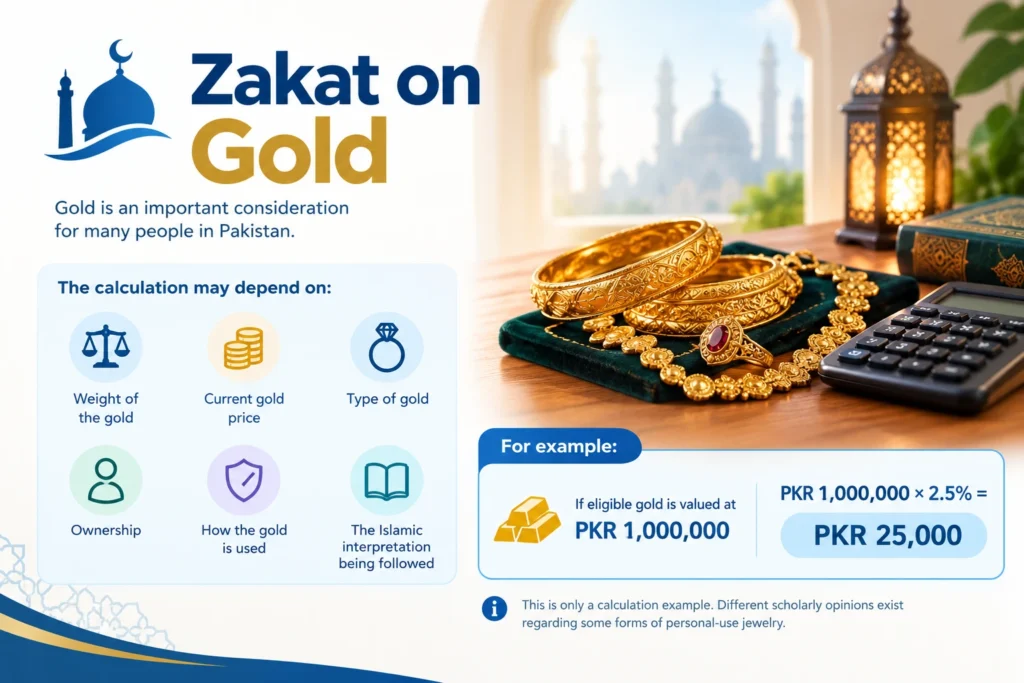
Gold is an important consideration for many people in Pakistan.
If you own gold jewelry or other gold assets, the calculation may depend on:
- Weight of the gold
- Current gold price
- Type of gold
- Ownership
- How the gold is used
- The Islamic interpretation being followed
For example, if eligible gold is valued at PKR 1,000,000:
PKR 1,000,000 × 2.5% = PKR 25,000
This is only a calculation example. Different scholarly opinions exist regarding some forms of personal-use jewelry.
Zakat on Silver
Silver may also be relevant when calculating Zakat or determining Nisab.
Because silver prices change, the PKR value should be based on an appropriate current market price.
For example, if eligible silver is valued at PKR 300,000:
PKR 300,000 × 2.5% = PKR 7,500
Again, this example demonstrates the mathematics and does not determine an individual’s religious obligation.
Zakat on Business Assets
Business owners may have additional assets to consider.
Depending on the applicable rules, Zakat may apply to certain business inventory and assets intended for sale.
Examples may include:
- Products held for sale
- Trading inventory
- Business cash
- Certain receivables
Business owners should not automatically apply 2.5% to everything connected with their business without considering the relevant Zakat rules.
For a complicated business situation, consulting a qualified scholar or knowledgeable Islamic finance professional can be helpful.
Zakat on Investments
Investments can require additional consideration because different types of investments may be treated differently.
Examples include:
- Shares
- Mutual funds
- Investment accounts
- Other financial assets
The treatment may depend on the nature of the investment and the reason it is being held.
For this reason, an online calculator should be considered a calculation aid rather than a replacement for individual religious guidance.

Can Debts or Liabilities Be Deducted?
Some Zakat calculation methods allow certain liabilities or debts to be deducted.
However, not every debt should automatically be subtracted.
The treatment can depend on:
- Type of debt
- Amount currently due
- Repayment period
- Islamic school of thought
- Individual circumstances
If you have significant debts or complex financial obligations, check the method you follow before making deductions.
How to Use a Zakat Calculator in Pakistan
Using an online Zakat calculator is generally simple.
Step 1: Collect Your Financial Information
Prepare the values of your relevant:
- Cash
- Bank balances
- Gold
- Silver
- Business assets
- Investments
- Other eligible assets
- Applicable liabilities
Step 2: Enter Your Amounts
Enter the values into the appropriate calculator fields.
For a Pakistan-focused calculator, enter amounts in PKR.
Step 3: Check the Nisab
Review the applicable Nisab according to the calculation method you follow.
Step 4: Calculate Your Zakat
Submit the information to calculate the estimated amount.
Step 5: Review the Result
If your situation includes complex investments, business assets, debts, or questions about jewelry, consider checking the result with a qualified scholar.
Zakat Calculation Example for Pakistan
Consider this simple example:
| Asset | Value |
|---|---|
| Cash | PKR 150,000 |
| Bank savings | PKR 350,000 |
| Eligible gold value | PKR 250,000 |
| Other eligible assets | PKR 50,000 |
| Total | PKR 800,000 |
PKR 800,000 × 2.5% = PKR 20,000
Therefore, the estimated Zakat is:
PKR 20,000
This example is intended to explain the calculation. The actual treatment of individual assets depends on the applicable Zakat rules.
Why Use an Online Zakat Calculator?
Calculating Zakat manually can become difficult when you have several different types of assets.
An online calculator can help you:
- Organize your financial information
- Perform basic calculations quickly
- Reduce arithmetic mistakes
- Estimate your Zakat amount
- Work with PKR amounts
- Recalculate when asset values change
For Pakistani users, a calculator designed around Pakistani rupees can make the process easier to understand.
Zakat Calculator vs Manual Calculation
| Feature | Manual Calculation | Online Zakat Calculator |
|---|---|---|
| Basic calculation | Yes | Yes |
| Multiple assets | Can be difficult | Easier |
| Quick result | Depends on user | Usually faster |
| PKR amounts | Yes | Yes |
| Arithmetic assistance | Manual | Automatic |
| Asset organization | Manual | Structured |
An online calculator can be useful for getting a quick estimate before reviewing the details of your calculation.
When Should Zakat Be Calculated?
The timing of Zakat depends on an individual’s Zakat anniversary and the applicable Islamic rules.
Many Muslims select a particular Islamic date each year to review their Zakatable wealth.
Keeping basic financial records throughout the year can make the calculation easier when the Zakat date arrives.
If you are unsure about your Zakat anniversary or how it should be determined, consult a qualified scholar.
Does Zakat Apply to Everyone?
No.
Zakat is not a fixed payment that every person must make regardless of their financial circumstances.
Eligibility depends on conditions such as ownership of sufficient Zakatable wealth and the applicable rules concerning Nisab and the required period.
A person whose wealth does not meet the relevant conditions may not have the same Zakat obligation as someone whose wealth does.

Common Mistakes When Calculating Zakat
1. Using an Old Gold or Silver Price
Gold and silver prices change. Using an outdated price can affect the calculation.
2. Forgetting Bank Savings
Some people calculate only their cash at home and forget money held in bank accounts.
3. Deducting Every Debt Automatically
Debt treatment can vary. Do not assume every outstanding payment should automatically be deducted.
4. Mixing Personal and Business Assets
Business owners may need to examine business-related assets separately and carefully.
5. Treating the Calculator as a Religious Ruling
A calculator performs mathematical calculations based on the information provided. It does not replace qualified religious guidance.
Zakat FAQs
Find simple answers to common questions about Zakat calculation, Nisab, the 2.5% rate, and Zakatable wealth in Pakistan.
The commonly used Zakat rate for many forms of eligible monetary wealth is 2.5%. The exact calculation can depend on the type of asset and the Islamic rules you follow.
At a 2.5% rate, Zakat on PKR 100,000 is PKR 2,500, assuming the amount is fully Zakatable and the required conditions are met.
At 2.5%, Zakat on PKR 500,000 is PKR 12,500, assuming the amount qualifies for Zakat.
At a 2.5% rate, Zakat on PKR 1,000,000 is PKR 25,000, assuming the required Zakat conditions are met.
Bank balances may be included when calculating Zakat according to the rules and calculation method you follow. Your exact situation may depend on debts, savings, and other Zakatable assets.
Gold can be subject to Zakat when the applicable conditions are met. The treatment of personal-use jewelry can differ among scholarly opinions, so consider the method you follow.
Yes. A Zakat Calculator can help estimate Zakat by allowing you to enter eligible assets and other required information.
2.5% is commonly used for many forms of monetary wealth when the relevant conditions are met. Some other categories of wealth can have different calculation rules.
Nisab is the minimum wealth threshold relevant to Zakat eligibility. It is traditionally associated with the value of gold or silver, depending on the method followed.
For a simple calculation, a calculator can help with the mathematics. If you have complex investments, business assets, debts, jewelry, or Nisab questions, consulting a qualified scholar can help clarify the applicable rules.