How to Calculate Percentage in Pakistan: Formula, Examples & Percentage Calculator
Percentages are part of everyday life in Pakistan. Students check exam results in percentage, shoppers calculate discounts during sales, and employees compare salary increases year after year. Yet many people still find percentage calculations confusing, especially with increases, decreases, or comparisons between two values.
This guide explains everything you need to know about how to calculate percentage—from the basic formula to real examples from schools, shops, and salaries in Pakistan, along with a free tool from GetCalculatorHub to make it even easier.
What Is a Percentage?
A percentage is a way of expressing a number as a part of 100. It shows how large or small one value is compared to a whole, using 100 as the common reference point.
For example, if you score 80 marks out of 100 in a test, your percentage is simply 80%. If the total marks were different—say 80 out of 120—the percentage would need to be calculated so it can be compared fairly with other results on the same 100-point scale.
Percentages make comparison easy. Instead of saying “17 out of 20” or “68 out of 80,” we convert both into percentages so they can be compared directly, since both would equal 85%.
What Does % Mean?
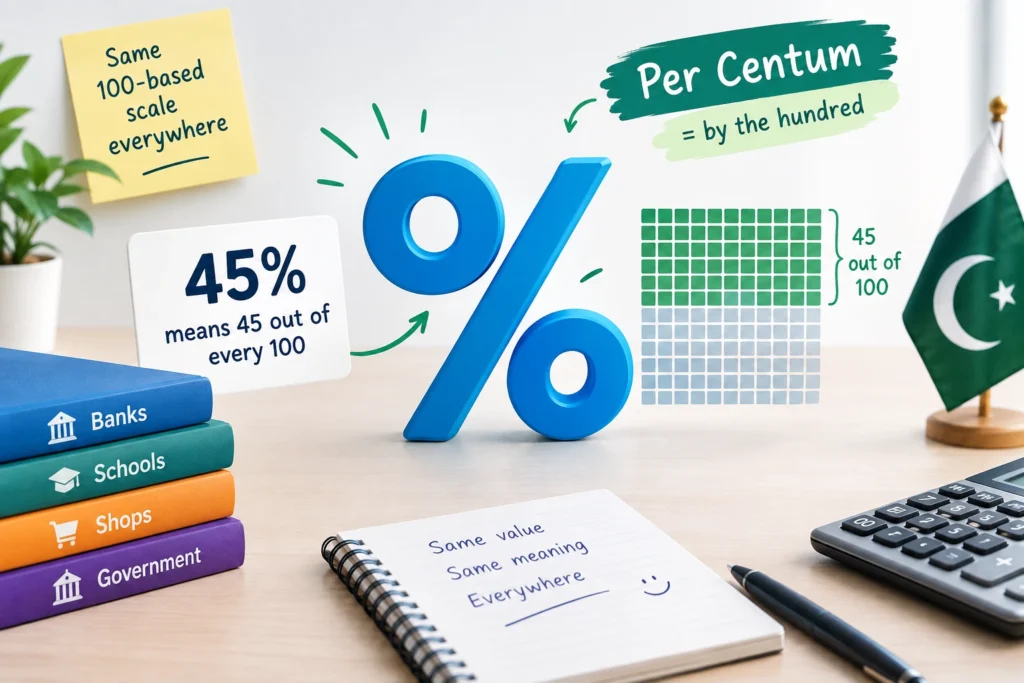
The symbol % stands for “per hundred.” It comes from the Latin phrase per centum, meaning “by the hundred.” “So when you see 45%, it simply means 45 out of every 100.
This is why percentages are so useful in daily life—banks, schools, shops, and government departments in Pakistan all use the same 100-based scale, making it a universal way to compare values regardless of the original numbers involved.
What Is the Basic Percentage Formula?
The basic percentage formula is Percentage = (Part ÷ Whole) × 100.
This formula answers the most common question people search for. Here, “Part” is the specific value you are measuring, and “Whole” is the total amount it is being compared against. Multiplying by 100 converts the result into a percentage.
| Term | Meaning |
|---|---|
| Part | The specific amount or value you want to express as a percentage |
| Whole | The total or base value |
| Percentage | The result, expressed out of 100 |
This one formula is the foundation for almost every percentage calculation you will ever need—marks, discounts, salary changes, and more.
How Do You Calculate a Percentage? (Step-by-Step)
To calculate a percentage, divide the part by the whole, then multiply the result by 100.
Here is the process broken down into simple steps:
- Identify the “part”—the specific number you are measuring.
- Identify the “whole”—the total or base number.
- Divide the part by the whole.
- Multiply the answer by 100.
- Add the % symbol to your final result.
Example: Suppose 45 students out of 60 passed an exam. What percentage passed?
- Part = 45, Whole = 60
- 45 ÷ 60 = 0.75
- 0.75 × 100 = 75
So, 75% of the students passed the exam.
How Do You Calculate Percentage From Marks?
To calculate the percentage from marks, divide the marks obtained by the total marks, then multiply by 100.
This is one of the most searched percentage calculations in Pakistan, especially around matric, intermediate, and university result seasons.
Formula: Percentage = (Obtained Marks ÷ Total Marks) × 100
Example: A student obtains 850 marks out of 1100 in matric exams.
- 850 ÷ 1100 = 0.7727%
The student’s percentage is approximately 77.27%.
Marks Percentage Table
| Obtained Marks | Total Marks | Percentage |
|---|---|---|
| 450 ★ | 550 | 81.82% |
| 850 | 1100 | 77.27% |
| 950 | 1200 | 79.17% |
| 300 | 400 | 75.00% |
| Average | — | 78.32% |
Students applying for college or university admissions often need this number quickly and accurately, since even a small rounding error can affect merit calculations. Along with a percentage calculator, students working on admissions may also find our Age Calculator useful for checking eligibility criteria based on age limits.
How Do You Calculate the Percentage of a Number?
To find the percentage of a number, multiply the number by the percentage, then divide by 100.
Example: What is 20% of 1,500?
- 20 × 1500 = 30,000
- 30,000 ÷ 100 = 300
So, 20% of 1,500 is 300.
This calculation is used constantly in daily life—from working out tips to zakat contributions to understanding what portion of your income goes toward savings or expenses. If you’re calculating your annual zakat obligation, the Zakat Calculator applies this exact type of percentage logic automatically.
How Do You Calculate Percentage Increase?
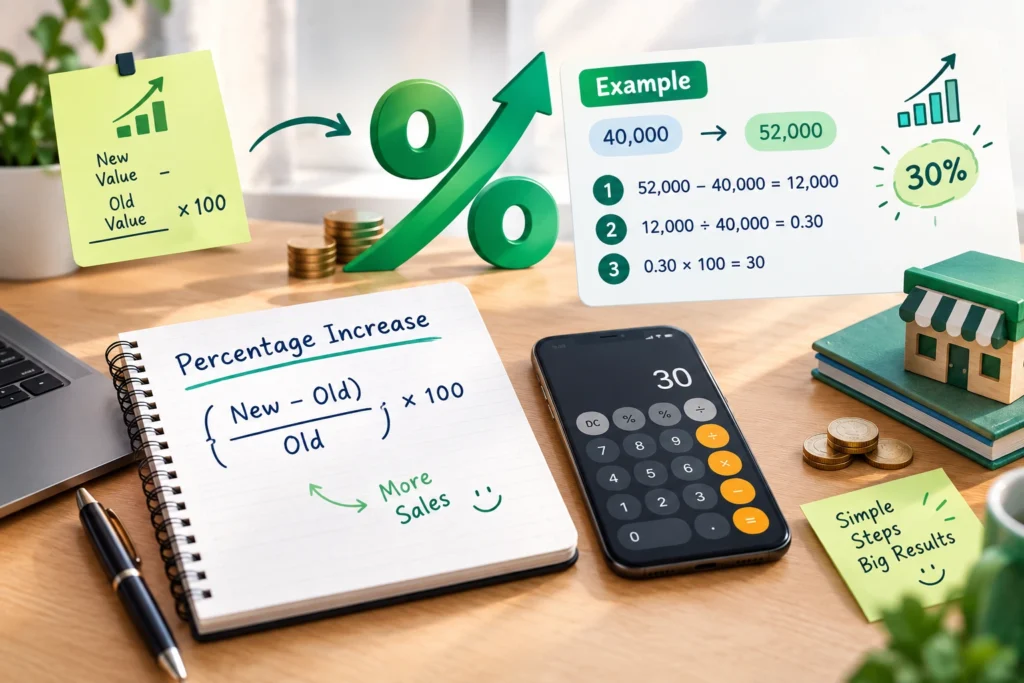
To calculate the percentage increase, subtract the old value from the new value, divide by the old value, and then multiply by 100.
Formula: Percentage Increase = [(New Value − Old Value) ÷ Old Value] × 100
Example: A shopkeeper’s monthly sales increased from Rs. 40,000 to Rs. 52,000.
- New − Old = 52,000 − 40,000 = 12,000
- 12,000 ÷ 40,000 = 0.30
- 0.30 × 100 = 30
Sales increased by 30%.
Formula: Percentage Increase = [(New Value − Old Value) ÷ Old Value] × 100
Example: A shopkeeper’s monthly sales increased from Rs. 40,000 to Rs. 52,000.
- New − Old = 52,000 − 40,000 = 12,000
- 12,000 ÷ 40,000 = 0.30
- 0.30 × 100 = 30
Sales increased by 30%.
How Do You Calculate Percentage Decrease?
To calculate percentage decrease, subtract the new value from the old value, divide by the old value, and then multiply by 100.
Formula: Percentage Decrease = [(Old Value − New Value) ÷ Old Value] × 100
Example: A product’s price dropped from Rs. 2,500 to Rs. 2,000.
- Old − New = 2,500 − 2,000 = 500
- 500 ÷ 2,500 = 0.20
- 0.20 × 100 = 20
The price decreased by 20%.
Increase vs Decrease Comparison
| Situation | Formula | Result Meaning |
|---|---|---|
| Value goes up | (New − Old) ÷ Old × 100 | Percentage increase |
| Value goes down | (Old − New) ÷ Old × 100 | Percentage decrease |
Percentage Change vs Percentage Difference
People often confuse these two terms, but they are not the same thing.
Percentage change measures how much a value has moved from an original (starting) point to a new point. It always uses the original value as the base.
Percentage difference compares two values without treating either one as the “original.” It is typically used when comparing two independent quantities, such as two products or two test scores.
In short: use percentage change for tracking something over time (like salary or sales), and use percentage difference when comparing two separate, unrelated values.
Percentage Examples in Daily Life
Percentages appear far more often than most people realize:
- Bank profit rates and markup on savings accounts
- Mobile load and internet package discounts
- Exam results and admission merit lists
- Import duties and sales tax on goods
- Loan markup and installment plans
- Population growth and inflation rate reports
Understanding percentages helps you make better financial and academic decisions.
Shopping Discounts and Percentages
Sales and discount offers are one of the most common places Pakistanis use percentage calculations, especially during Eid sales, Independence Day sales, and year-end clearance offers.
Formula: Discounted Price = Original Price − [(Discount % × Original Price) ÷ 100]
Example: A shirt priced at Rs. 3,000 is on sale with a 25% discount.
Discount amount = (25 × 3000) ÷ 100 = 750
Discounted price = 3000 − 750 = Rs. 2,250
Common Discount Examples
| Original Price | Discount % | Discount Amount | Final Price |
|---|---|---|---|
| Rs. 1,000 | 10% | Rs. 100 | Rs. 900 |
| Rs. 3,000 | 25% | Rs. 750 | Rs. 2,250 |
| Rs. 5,500 | 40% | Rs. 2,200 | Rs. 3,300 |
| Rs. 12,000 | 15% | Rs. 1,800 | Rs. 10,200 |
Example: Salary Increase
An employee's salary increased from Rs. 60,000 to Rs. 69,000 after an annual increment.
- Increase = 69,000 − 60,000 = 9,000
- 9,000 ÷ 60,000 = 0.15
- 0.15 × 100 = 15
The salary increased by 15%.
This same logic applies when calculating income tax deductions — if you want to know how much tax will be deducted from your monthly salary, the same increase/decrease formula helps you work it out.
Salary and Price Percentage Calculations
Percentage calculations are also essential when reviewing salary increases, annual increments, or comparing job offers.salary in Pakistan, the Salary Tax Calculator uses percentage-based tax slabs to give an accurate estimate based on current rules.
How to Use an Online Percentage Calculator
Using an online percentage calculator is much faster than manual calculation, especially when working with decimals or large numbers.
Here’s how to use the GetCalculatorHub Percentage Calculator:
- Choose the type of calculation you need (percentage of a number, percentage increase/decrease, or percentage from marks).
- Enter the required values into the input fields.
- Click “Calculate.”
- View your accurate result instantly, without doing any manual math.
This removes the chance of manual calculation errors. International tools such as calculator.net’s Percent Calculator use the same basic formula, but GetCalculatorHub’s version is built with Pakistan-specific examples, like mark percentage and rupee-based discounts.
Benefits of Using a Percentage Calculator
- Saves time compared to manual calculation, especially with decimal-heavy numbers
- Reduces errors that commonly occur in manual division and multiplication
- Handles multiple calculation types in one place: basic percentage, increase, decrease, and marks-based percentage
- Useful for students, shopkeepers, and employees alike, regardless of math background
- Free and accessible from any device, anytime
Similarly, other everyday calculations—such as checking BMI, tracking a pregnancy due date, or calculating the number of days between two dates—can be handled quickly using tools like the BMI Calculator, Pregnancy Due Date Calculator, and Date Difference Calculator.
Common Percentage Calculation Mistakes
Even simple percentage problems can go wrong due to small errors. Here are mistakes to watch for:
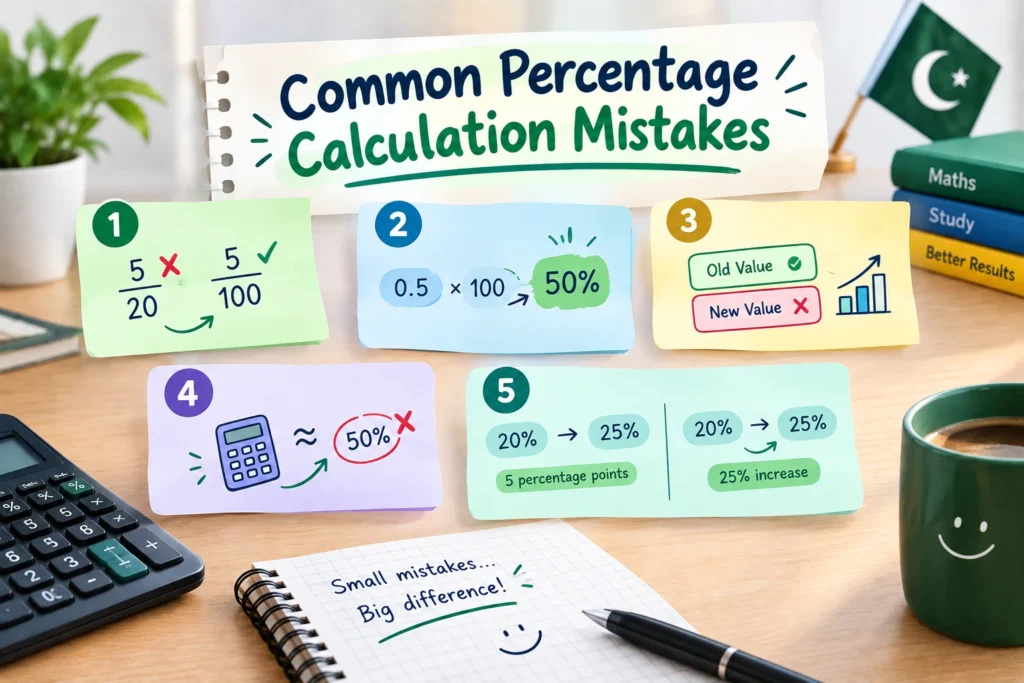
- Mixing up the part and the whole — always divide the smaller measured value by the total, not the other way around.
- Forgetting to multiply by 100 — this is the step that converts a decimal into a percentage.
- Using the wrong base value for increase/decrease — percentage increase and decrease should always be calculated using the original (old) value as the base, not the new one.
- Rounding too early — round your final answer only, not the numbers in the middle of the calculation, to avoid inaccurate results.
- Confusing percentage points with percentage change — going from 20% to 25% is a 5 percentage point increase, but it is actually a 25% percentage increase relative to the original 20%.
Avoiding these mistakes ensures your results stay accurate.
Frequently Asked Questions About Percentages
Simple answers to common questions about percentage formulas, percentage increase/decrease, and marks-based percentage calculation.
Pingback: How to Calculate Percentage Increase and Decrease