How to Calculate Monthly Car Payments
Buying a car is a big financial decision. Before choosing a new or used vehicle, it helps to know how much you will pay each month. A car payment loan calculator can estimate your monthly payment based on the loan amount, interest rate, and repayment period. You can also account for a down payment, taxes, and fees to get a more realistic estimate.
In this guide, you will learn how to calculate monthly car payments, understand interest costs, compare different loan terms, and decide whether a car fits your budget. The examples mainly use US dollars, with additional notes for Pakistan and India.
What Is a Monthly Car Payment?
A monthly car payment is the amount you pay to a lender each month to repay a car loan. Your payment usually includes two main parts: principal and interest.
The principal is the amount you borrow to buy the vehicle. Interest is the cost charged by the lender for lending you the money.
For example, suppose you borrow $20,000 to purchase a car. You agree to repay the loan over 60 months at a fixed annual interest rate of 6%. Your monthly payment will be approximately $386.66.
Over the full loan term, you will pay about $23,199.60. This includes the original $20,000 loan and approximately $3,199.60 in interest.
Your actual payment may differ if the loan includes additional fees, optional products, or different interest-rate terms.
What Information Do You Need to Calculate a Car Payment?
Before using a monthly car payment calculator, collect a few important details. Accurate inputs help you estimate your future payments more clearly.
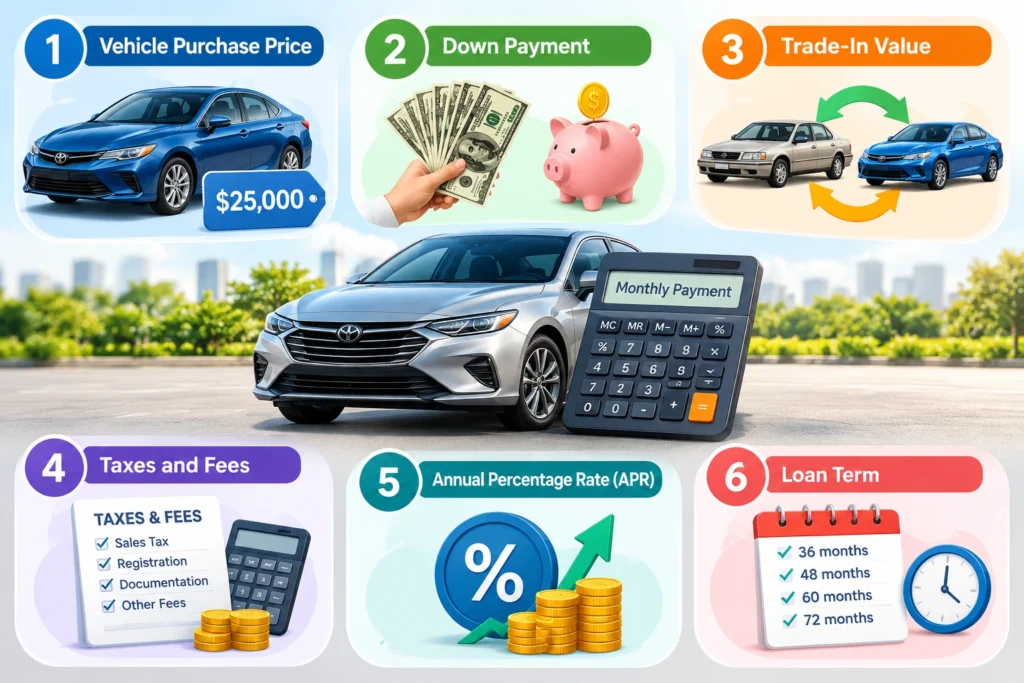
1. Vehicle Purchase Price
The purchase price is the amount the seller charges for the car before applicable taxes and additional fees.
For example, if a vehicle costs $25,000, that is your starting price. However, the final amount you need to finance may be higher or lower.
2. Down Payment
A down payment is the money you pay upfront when buying a vehicle.
If your car costs $25,000 and you pay $5,000 upfront, you may need to finance the remaining $20,000 before taxes and fees.
A larger down payment generally reduces the amount you borrow, which can lower your monthly payment and total interest.
3. Trade-In Value
If you already own a car, you may trade it in when purchasing another vehicle.
Suppose the dealer offers $4,000 for your old car. If you have no outstanding loan on that vehicle, the trade-in value may reduce the amount you need to finance.
If you still owe money on your current car, the remaining loan balance must also be considered.
4. Taxes and Fees
Depending on where you buy the vehicle, you may need to pay sales tax, registration charges, documentation fees, and other costs.
Some eligible taxes and fees may be added to the loan. If you pay them upfront, they do not need to be included in the financed amount.
5. Annual Percentage Rate (APR)
The annual percentage rate, or APR, helps you understand the cost of borrowing. It reflects the interest rate and, depending on the applicable rules and loan structure, certain borrowing fees.
A higher rate generally increases your monthly payment and total interest when the loan amount and term stay the same.
6. Loan Term
The loan term is the period over which you repay the loan. Common car loan terms include 36, 48, 60, and 72 months.
A shorter term usually means higher monthly payments but less total interest. A longer term usually lowers the monthly payment while increasing the total interest paid.
How to Calculate Monthly Car Payments Step by Step
You can estimate a car payment manually or use an online car loan payment calculator.
Follow these steps to understand how the calculation works.
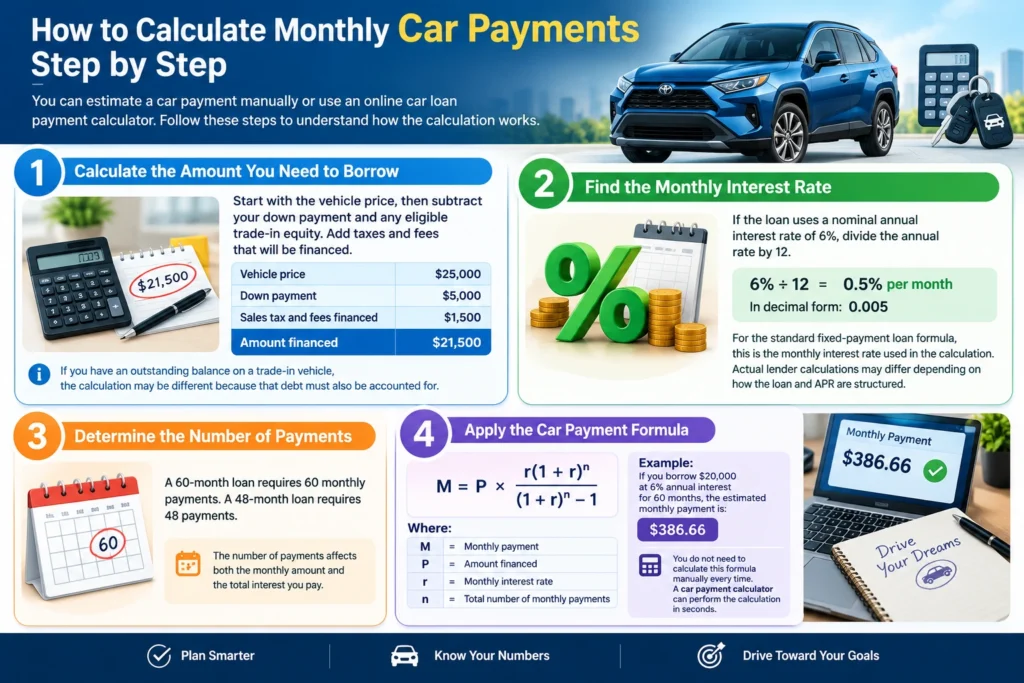
Step 1: Calculate the Amount You Need to Borrow
Start with the vehicle price, then subtract your down payment and any eligible trade-in equity.
Add taxes and fees that will be financed.
In this example, you need to borrow $21,500.
| Expense | Amount |
|---|---|
| Vehicle price | $25,000 |
| Down payment | $5,000 |
| Sales tax and fees financed | $1,500 |
| Amount financed | $21,500 |
If you have an outstanding balance on a trade-in vehicle, the calculation may be different because that debt must also be accounted for.
Step 2: Find the Monthly Interest Rate
If the loan uses a nominal annual interest rate of 6%, divide the annual rate by 12.
6% ÷ 12 = 0.5% per month.
In decimal form, the monthly rate is 0.005.
For the standard fixed-payment loan formula, this is the monthly interest rate used in the calculation. Actual lender calculations may differ depending on how the loan and APR are structured.
Step 3: Determine the Number of Payments
A 60-month loan requires 60 monthly payments. A 48-month loan requires 48 payments.
The number of payments affects both the monthly amount and the total interest you pay.
Step 4: Apply the Car Payment Formula
The standard formula for a fixed-rate loan with equal monthly payments is:
Where:
| Symbol | Meaning |
|---|---|
| M | Monthly payment |
| P | Amount financed |
| r | Monthly interest rate |
| n | Total number of monthly payments |
For example, if you borrow $20,000 at 6% annual interest for 60 months, the estimated monthly payment is $386.66.
You do not need to calculate this formula manually every time. A car payment calculator can perform the calculation in seconds.
Monthly Car Payment Examples
The following examples show how loan amounts, interest rates, and repayment periods affect your monthly payment.
These estimates assume a fixed interest rate, equal monthly payments, and no additional financed fees beyond the stated loan amount.
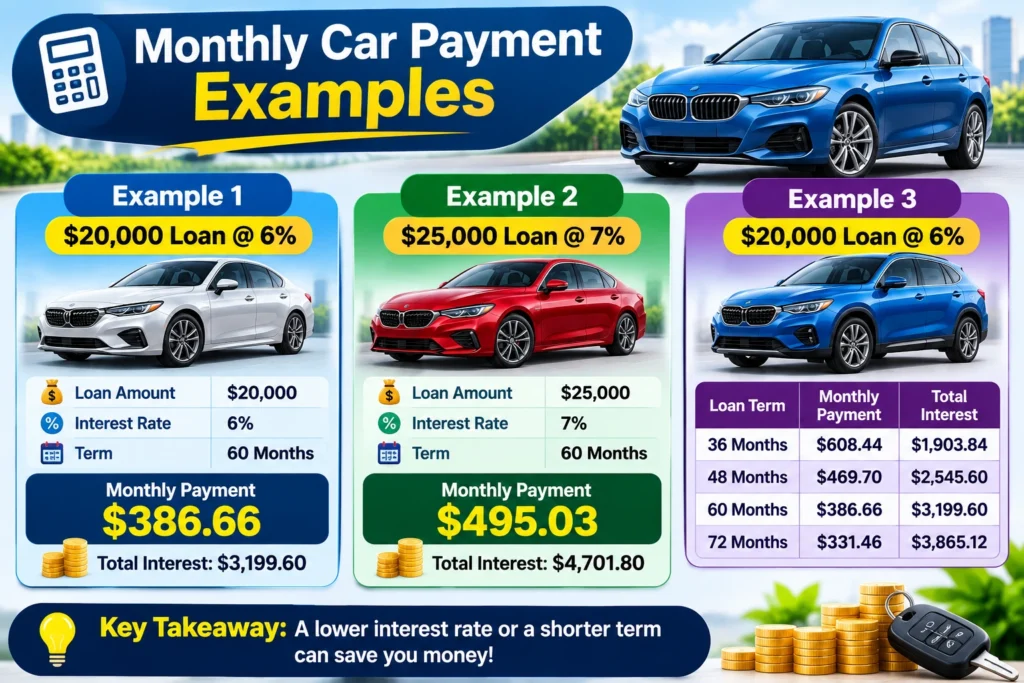
Example 1: A $20,000 Car Loan at 6% Interest
Suppose you borrow $20,000 at a 6% annual interest rate and choose a 60-month repayment period.
| Loan detail | Amount |
|---|---|
| Amount financed | $20,000 |
| Annual interest rate | 6% |
| Loan term | 60 months |
| Estimated monthly payment | $386.66 |
| Total payments | $23,199.60 |
| Total interest | $3,199.60 |
This example shows why you should look beyond the vehicle’s price. The interest adds about $3,199.60 to the cost of borrowing.
Example 2: A $25,000 Car Loan at 7% Interest
Now suppose you borrow $25,000 at a 7% annual interest rate for 60 months.
| Loan detail | Amount |
|---|---|
| Amount financed | $25,000 |
| Annual interest rate | 7% |
| Loan term | 60 months |
| Estimated monthly payment | $495.03 |
| Total payments | $29,701.80 |
| Total interest | $4,701.80 |
The higher loan amount and interest rate lead to a higher monthly payment.
Comparing financing offers can help you understand whether a lower interest rate or a smaller loan would make the vehicle more affordable.
Example 3: Comparing Different Loan Terms
Consider a $20,000 car loan with a fixed annual interest rate of 6%.
The following table compares four common loan terms.
| Loan term | Monthly payment | Total payments | Total interest |
|---|---|---|---|
| 36 months | $608.44 | $21,903.84 | $1,903.84 |
| 48 months | $469.70 | $22,545.60 | $2,545.60 |
| 60 months | $386.66 | $23,199.60 | $3,199.60 |
| 72 months | $331.46 | $23,865.12 | $3,865.12 |
The 36-month loan has the highest monthly payment but the lowest total interest among these options.
The 72-month loan has a lower monthly payment, but you pay approximately $1,961.28 more in interest than with the 36-month loan.
The right choice depends on your income, essential expenses, savings, and the loan terms available to you.
How Do Down Payments Affect Monthly Car Payments?
A down payment reduces the amount you need to borrow.
Suppose you want to buy a $25,000 car and finance it over 60 months at a fixed annual interest rate of 6%. For a simple comparison, assume taxes and fees are paid separately.
| Down payment | Amount financed | Estimated monthly payment |
|---|---|---|
| $0 | $25,000 | $483.32 |
| $3,000 | $22,000 | $425.33 |
| $5,000 | $20,000 | $386.66 |
| $7,000 | $18,000 | $347.99 |
As the down payment increases, the monthly payment decreases because you are borrowing less money.
However, using all your available savings for a down payment may leave you without enough money for emergencies. Consider your other financial needs before deciding how much to pay upfront.
How Does the Interest Rate Affect Your Car Payment?
The interest rate affects how much you pay for borrowing money.
When the loan amount and repayment term stay the same, a higher interest rate usually results in a higher monthly payment and greater total interest.
For example, consider a $20,000 loan over 60 months.
| Annual interest rate | Estimated monthly payment | Approximate total interest |
|---|---|---|
| 4% | $368.33 | $2,099.80 |
| 6% | $386.66 | $3,199.60 |
| 8% | $405.53 | $4,331.80 |
These figures are estimates based on standard fixed-payment calculations.
The rate a lender offers may depend on your credit history, income, debt, loan term, vehicle, and lender policies. Not everyone will qualify for the same rate.
When comparing financing offers, review the APR, loan duration, fees, and total repayment amount rather than looking only at the monthly payment.
For additional guidance, the Consumer Financial Protection Bureau’s guide to comparing auto loan offers explains why the overall cost matters.
Is a 36-, 48-, 60-, or 72-Month Car Loan Better?
Each loan term has advantages and disadvantages. Your decision should balance the monthly payment with the total amount you will repay.
36-month loan: This option helps you repay the debt faster and generally reduces total interest. However, the monthly payment is higher.
48-month loan: This offers a middle ground between repayment speed and monthly cost.
60-month loan: A five-year term spreads payments over a longer period, making each payment lower than it would be with a shorter term.
72-month loan: A six-year term may make a vehicle seem more affordable each month. However, it generally increases total interest and keeps you in debt longer.
A lower monthly payment does not automatically mean a better deal. If you can comfortably afford a shorter term, compare its total cost with a longer loan before deciding.
Also consider how long you expect to keep the vehicle. With a long loan, you may still owe money when the car’s market value has fallen significantly.
Additional Costs to Consider Before Buying a Car
Your monthly loan payment is only one part of owning a vehicle. A realistic budget should include other regular and occasional expenses.
Car Insurance
Insurance protects you against certain financial losses. The required coverage and cost depend on your location, vehicle, driving history, and policy.
Get insurance estimates before finalizing your purchase.
Fuel or Electricity
Gasoline and electricity costs depend on how far you drive and how efficient your vehicle is.
A car with a lower loan payment may still cost more to operate if it uses more fuel.
Maintenance and Repairs
Oil changes, tires, brakes, routine servicing, and unexpected repairs can add to your expenses.
The age and condition of a used car may affect these costs.
Registration, Taxes, and Fees
Registration and vehicle taxes vary by location. Some expenses occur at purchase, while others may recur annually.
Other Ownership Costs
Parking, tolls, inspections, and roadside assistance may also affect your budget.
To organize these expenses, use the GetCalculatorHub monthly budgeting guide. It can help you compare your expected car costs with your income and other monthly commitments.
How to Estimate Your Car Payment More Easily
An online car payment calculator makes it easier to compare different financing options without repeating the formula manually.
To get a useful estimate, enter the amount you plan to finance, the annual interest rate, and the number of monthly payments. If the calculator supports additional inputs, include your down payment, taxes, fees, and trade-in equity.
Try changing one value at a time.
For example, calculate your payment using a 48-month term and then a 60-month term. Compare the monthly amounts, total interest, and total repayment.
You can also use the GetCalculatorHub Loan Calculator to explore loan payment and interest estimates. Check the calculator’s available inputs before relying on it for a specific car loan scenario.
Remember that a calculator provides an estimate, not a lender’s final offer. The actual payment depends on the final loan agreement.
Car Loan Calculations in the USA, Pakistan, and India
The basic idea behind a fixed-payment car loan is similar in many countries, but taxes, fees, currencies, financing structures, and lending rules can differ.
United States
US buyers should consider the vehicle price, down payment, sales tax, registration, dealer fees, APR, and loan term.
Sales tax and registration charges may vary by state and locality. Ask the dealer for an itemized out-the-door price so you can understand the complete purchase cost.
Compare loan offers using the same amount financed and repayment period whenever possible.
Pakistan
In Pakistan, car financing is usually discussed in Pakistani rupees (PKR). Buyers should check the bank’s current financing terms, applicable fees, repayment schedule, and any requirements for the vehicle.
Islamic auto financing may use a different contract structure from a conventional interest-based loan. Do not assume that every financing product can be calculated using the same interest formula.
Use the actual payment schedule supplied by your bank or financing provider for a reliable estimate.
India
In India, car financing is commonly calculated in Indian rupees (INR). Buyers should compare the lender’s stated rate, loan tenure, processing fees, down payment, and repayment schedule.
The meaning and calculation of the quoted rate may depend on the lender’s terms. Confirm whether charges are included in the loan or paid upfront.
For all three countries, calculate costs in the relevant local currency and use the lender’s actual terms when making a final decision.
Final Thoughts
Understanding your monthly car payment before buying a vehicle can help you make a more informed financial decision. The amount you borrow, the interest rate, and the repayment period all affect what you pay each month and how much the loan costs overall.
Use a car payment calculator to compare different scenarios, test possible down payments, and review total interest. Remember to include insurance, fuel, maintenance, taxes, and other ownership costs in your budget.
Before accepting a financing offer, compare the full repayment amount and read the loan terms carefully. Choosing a car that fits your overall budget is more important than choosing one that simply offers a low monthly payment.