
Age Calculator by Date of Birth: Find Your Exact Age (2026)
Need your exact age right now? Use the age calculator by date of birth above. Enter your birth date and you will see your age in year’s month’s and day’s. You will also see the total days you have lived and the day’s left until your next birthday. It takes a few second’s and it is free. Below you will learn how age is counted how to calculate it by hand, how leap years and month length change the numbers and why two calculators sometimes show different result’s.
What Is an Age Calculator by Date of Birth?
An age calculator by date of birth is a simple online tool that works out how old you are from the day you were born. You enter your birth date, and it compares it with today’s date or another date you pick. It then shows your age in years, months and days.
Age is counted in full completed years. A birthday counts only when that date is reached. Months and days are counted after your last birthday. The tool does all of this for you, so you do not need to count month lengths by hand.
What Results Will You See?
You will see your exact age in years, months and days. You will also see the total days you have lived and a countdown to your next birthday. Other numbers, like weeks and hours, are easy to work out from your total days, and we show how further down this page.
Who Uses an Age Calculator?
Students use it to check the age on an admission form. Job applicants use it to see if they meet an age limit. Parents use it to track a baby’s age. Some people use it to plan retirement, and many just want to calculate my exact age in years, months and days for fun.
How to Use This Age Calculator (Step by Step)
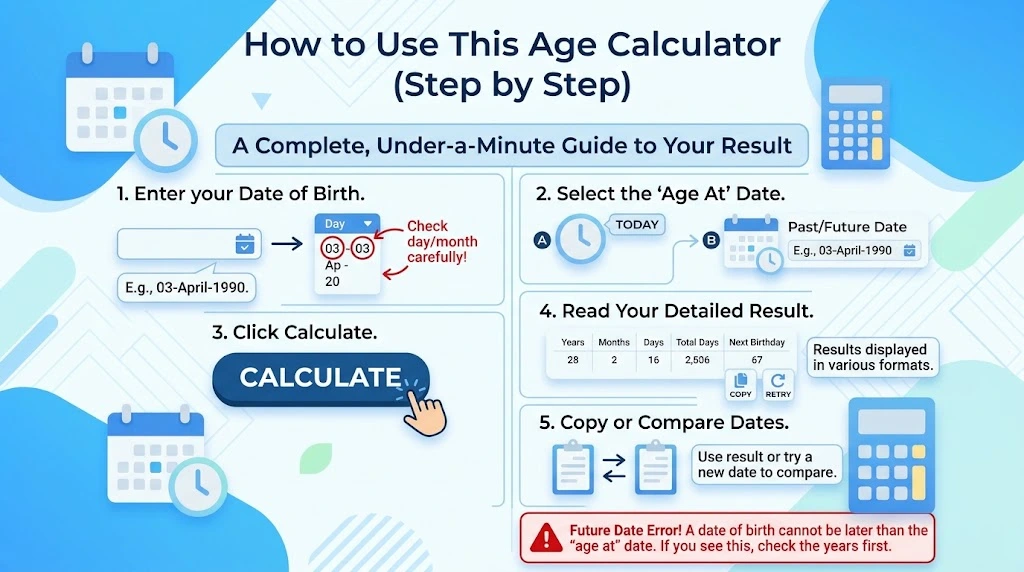
Using the tool takes under a minute. Enter your date of birth, check the date format, and leave the age at date as today or choose another date. Click calculate and read your result. You can then try a different date as many times as you like.
- Enter your date of birth. Select the date, and check that the day and month are not swapped.
- Leave the “age at” date as today. Or choose a past or future date if a form asks for your age on a set day.
- Click calculate.
- Read your result: years, months, days, total days and your next birthday.
- Copy your result, or try another date to compare.
If you see a future date error, check the year first. A date of birth cannot be later than the “age at” date.
How to Calculate Age from Date of Birth Manually
To calculate age from date of birth by hand, subtract the birth year from the current year, then check if the birthday has passed this year. If not, take away one year. Then count the full months since the last birthday, and finally count the leftover days.
Example: Date of birth 15 March 1995. Checked on 10 October 2026.
| Step | What to Do | Work in the Example |
|---|---|---|
| 1. Years | Subtract the birth year. Check if the birthday has passed. | 2026 minus 1995 is 31. The birthday on 15 March 2026 has passed, so it is 31 years. |
| 2. Months | Count full months after the last birthday. | 15 March 2026 to 15 September 2026 is 6 months. |
| 3. Days | Count the days left after those months. | 15 September to 10 October is 25 days. |
| Result | Put the three parts together. | 31 years, 6 months and 25 days. |
The tool gives the same answer. Always count years first, then months, then days. This order keeps the math clean.
How Month Length Changes the Day Count
Months are not all the same length. January, March, May, July, August, October and December have 31 days. April, June, September and November have 30 days. February has 28 days, or 29 days in a leap year.
When you count days, use the length of the month you are counting through. In the example above, September has 30 days. So 15 September to 30 September is 15 days. Add 10 more days to reach 10 October, and you get 25.
Example 2 With a Leap Year
Example 2: Date of birth 12 December 2003. Age checked on 5 March 2024. The year 2024 is a leap year, so February has 29 days.
The birthday on 12 December 2023 has passed, so that is 20 years. From 12 December 2023 to 12 February 2024 is 2 months. From 12 February to 29 February is 17 days. One more day reaches 1 March, and 4 more days reach 5 March. That adds up to 22 days.
The result is 20 years, 2 months and 22 days. In a normal year, February has only 28 days, and the same dates would give 21 days. That one day is the leap year effect and follow these terms and conditions and more tools.
Quick Summary: Which Age Result Do You Need?
The result you need depends on why you are checking your age. For forms, use completed years on the date the form asks about. For babies, weeks and months matter more. For birthdays, use the countdown. The table below matches each situation to the right result.
| Your Situation | What to Check | Result to Use | Tip |
|---|---|---|---|
| Job application form | The age limit and the date it is counted on | Completed years on that date | Set the "age at" date to the cut off date. Rules differ, so check the official notice. |
| School admission form | The minimum age and the counting date | Years, months and days on that date | Each school sets its own rule, so check the school's notice. |
| Baby age | Weeks and months since birth | Total days, then divide by 7 for weeks | Use months and days for the first year. |
| Retirement planning | The date you reach a set age | Completed years and your next birthday | Pension rules differ, so check the official rule. |
| Birthday countdown | Days until your next birthday | The next birthday result | Check again on the day, in case your time zone differs. |
| Age on a past date | The date of the event | Age at that date | Enter the past date in the "age at" box. |
Does a Leap Year Change Your Age?
No. A leap year adds one extra day, 29 February, but your age still grows by one full year on each birthday. The extra day only changes your total day count and, in some cases, the number of days shown after your last birthday.
In the Gregorian calendar, a year is a leap year when it divides by 4. Century years, like 1900 and 2100, are leap years only when they also divide by 400. So 2000 was a leap year, and 1900 was not.
What about a 29 February birthday? In years without that date, people usually celebrate on 28 February or 1 March. The legal treatment can differ by country. If you need an official tool web and answer, check the rule of the office or your country.
How Many Days, Weeks and Hours Old Am I?
Total days is the number of days between your birth date and the chosen date. Divide that by 7 for weeks. Multiply by 24 for hours. Hours are only an estimate unless you know your exact birth time, because the calculation treats every birth as starting at midnight.
Example: Date of birth 15 March 1995. Checked on 10 October 2026. The total is 11,532 days. Divide by 7 and you get 1,647 weeks and 3 days. Multiply by 24 and you get about 276,768 hours.
The same date of birth also tells you the day of the week you were born. In this example, 15 March 1995 was a Wednesday. The total includes the extra days from every 29 February in between.
Where Do People Need Their Exact Age?
People need an exact age for school admission, job applications, visa and passport forms, insurance, exam eligibility and retirement planning. Each office sets its own rules and its own counting date. This tool gives you a quick number, but you should always check the official rule of the office you are dealing with.
School admission. A school may count age on the first day of the session or on a set date. Rules differ, so read the admission notice.
Job applications. An age limit usually applies on a fixed cut off date. Set the “age at” date to that day and see the result.
Visa and passport forms. These forms often ask for age or date of birth in a set format. Follow the form exactly.
Insurance and exam eligibility. Some plans and exams use age on a given date. Check the official rule before you apply.
Retirement planning. Your result helps you see how many years and months remain until a set age. The official retirement age is set by your employer or your country.
How to Find the Age Difference Between Two People or Two Dates
To find the age difference between two people or two dates, subtract the earlier date from the later date. Count completed years first, then months, then days. You can also use this tool by entering the older date of birth and setting the second date in the age at box.
Example: Person A was born on 8 May 1990. Person B was born on 20 August 1993. From 8 May 1990 to 8 May 1993 is 3 years. From 8 May to 8 August is 3 months. From 8 August to 20 August is 12 days.
The age gap is 3 years, 3 months and 12 days. That is 1,200 days in total.
Why Your Result May Look Different From Another Calculator
Results can differ because of small input or method differences. The day and month may be swapped, the age at date may not be today, or the calculator may handle month end dates in a different way. Time zones can also change today’s date near midnight. Check these first.
Day and month swapped. The date 03/04/1995 means 3 April in some places and 4 March in others. Check the format.
A different age at date. One tool may use today, and another may use a set date. Make sure both use the same one.
Time zone. Near midnight, your date may already be tomorrow somewhere else.
Month end dates. Say you were born on 31 January 2000, and you check on 28 February 2026. One method counts 26 years, 1 month and 0 days. Another counts 26 years, 0 months and 28 days. Neither is a mistake. They treat the missing 31st in February in different ways.
A future date. If the date of birth is after the age at date, no age can be shown.
Common Mistakes People Make When Calculating Age
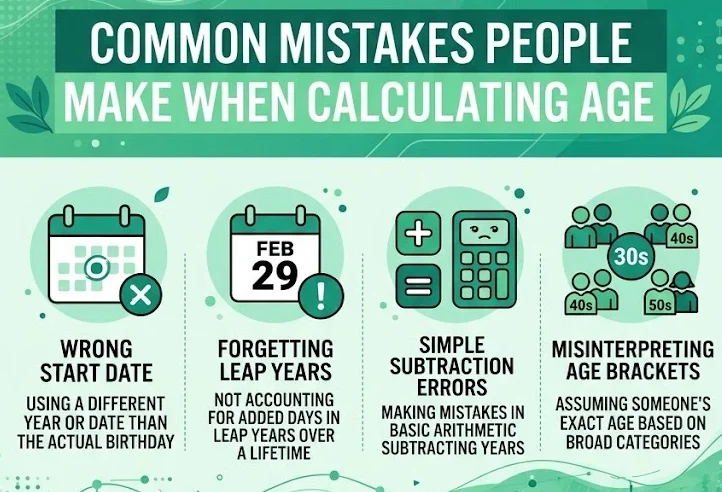
The most common mistakes are swapping day and month, forgetting that the birthday has not happened yet this year, and using 30 days for every month. Others are ignoring leap years and treating a calculator result as legal proof. Avoiding these errors keeps your answer accurate.
Another slip is subtracting only the years. If your birthday comes later in the year, you are still one year younger than the simple subtraction shows.
Also, do not count months from the wrong date. Months run from your last birthday, not from the start of the year.
Is This Age Calculator Accurate and Private?
The calculator follows the standard way of counting age: full years first, then months, then days. It runs in your browser, and it does not need your name or any personal details. Results are for personal use. A birth certificate or ID card is what proves your legal age.
We checked the worked examples on this page by hand, step by step, so you can repeat them and compare with the tool. If your result looks off, go back to the section on why results can differ.
This page is a helper, not an official record. For anything legal, rely on your official documents and the rules of the office you are dealing with.
Real Life Example Scenarios
These are examples, not real stories. Each one shows what a person typed into the calculator and what they learned. The dates are chosen so you can repeat the steps yourself and check the numbers. Check the rules of your own office before you rely on any result.
Example 1: A student checking an admission form. A parent enters a child’s date of birth, 10 June 2015, and sets the age at date to 1 April 2026. The result is 10 years, 9 months and 22 days. The parent then reads the school’s notice to see which counting date applies.
Example 2: A parent checking a baby’s age. A baby was born on 1 July 2026. The parent checks on 30 October 2026. The result is 0 years, 3 months and 29 days, which is 121 days. Divide 121 by 7 and the baby is 17 weeks and 2 days old.
Example 3: An adult counting days to a birthday. A person was born on 5 January 1990 and checks on 30 October 2026. The age is 36 years, 9 months and 25 days. The next birthday is 5 January 2027, which is 67 days away, and the person will turn 37.
Pingback: Calculate Age from Date of Birth: Easy Guide with Examples